Indian Holocaust My Father`s Life and Time - SEVEN HUNDRED FIVE
Palash Biswas
http://indianholocaustmyfatherslifeandtime.blogspot.com/
http://http://basantipurtimes.blogspot.com
Globalisation Riots Epicentre is Limited within Lodon for the Time Being but it may INFLICT other parts of the World specilly India anytime!Bengali Brahamin Kanya aspires to Make LONDON of Kolkata while her ally Brahamin PRANAB Mukherjee has MADE INDIA FREEMARKET Linked with US Corporate Imperialism. Our dear friend POSTOBABA is confused whom to support in such a crisis as CIVIL Society is NOT Concerned with either FREE Market Policies or Economic Reforms while the Marxists chose to run blind on the Highway of Capitalims to sustain Marxist Manusmriti Raj in Bengal and Failed miserably. The Marxist Betrayal led to LPG Mafia Rule for last Twenty years and NO Resistance whatsoever was Possible all these years! POSTOBABA is correct. We the People stranded in CONFUSION and IGNORANT about Policy Making and Governance Extraconstitutional, may NOT realise how the Financial System is DECONTROLLED and FIIs have taken over the Economy. It is Free FDI RAJ and New Bail Out Plan, Reforms and STIMULUS would lead to wider Ethnic Cleansing! The DEPRIVED EXCLUDED ENSLVED Masses subject to Mass Destruction may Rise any moment! RED ALERT!Now RABINDRA SANGGET is PITTED against Marxist Ideology. The LEFT has NO Base at all. While AMBEDKAEITES Fail to Rise above Casteology and have Discarded AMBEDKARITE Vision of ECONOMICS!They even Fail to face the Challenges to Constitutional Safeguards for the Excluded Communities!How should we AVOID the Imminent ANARCHY as the Sustenance of the Excluded Majority Masses has been made IMPOSSIBLE and I am afraid, alike London Rioters they would NOT be waiting for any Political or Ideological lead in the Struggle for Life and Existence!
Three dead as police flood London


Eerie calm in capital as riots spread elsewhere; Armed Sikhs guard London gurdwara
- 89%11%

Looters carry boxes out of a home cinema shop in Birmingham on Tuesday. Thousands of policemen prepared to deploy on London's streets on Tuesday night to head off rioters and looters who have rampaged through parts of the British capital virtually unchecked for the past three nights.
London: Thousands of extra police officers flooded into London on Wednesday in a bid to end Britain's worst rioting in a generation. An eerie calm prevailed in the capital, but unrest spread across England on a fourth night of violence driven by diverse and brazen crowds of young people.
Scenes of ransacked stores, torched cars and blackened buildings frightened and outraged Britons just a year before their country is to host next summer's Olympic Games, bringing demands for a tougher response from law enforcement. Police across the country have made more than 1,100 arrests since the violence broke out over the weekend.
UK riots: 3 British Asians mowed to death in Birmingham
London: Three British Asians, who were on the streets of Birmingham to protect their community from rioting groups, were killed when a speeding car mowed them down last night, making them the latest victims of the ongoing unrest in Britain.
- 100%0%

The police are treating the deaths as murder.
The three Asians killed have been identified as two brothers, Shahzad and Harry Hussain and their friend Musaver Ali.
The three had emerged from a mosque and were on the streets protecting their car wash company after the previous night's violence when the incident happened, reports said.
Kabir Khan Isakhel, relative of one of the dead said two cars running at high speed struck the three.
A police spokesman said: "They were not in the way or blocking the road. The car swerved towards them. They went flying up in the air."

Murray McGregor, a spokesman for West Midlands Ambulance Service (WMAS), said some people were attempting resuscitation on the men when the ambulance arrived, but it became apparent that they had suffered 'significant injuries'.
A spokesman for West Midlands police said: "Detectives investigating the death of the three following a road traffic collision in Birmingham this morning will today question a 32-year-old man on suspicion of murder".
It's understood the three -- were on foot in Dudley Road in the Winson Green area of the city when they were in collision with a car. All later died from their injuries in hospital," the police spokesman said.

"Officers arrested the man nearby and also recovered a vehicle, which will be examined by forensics experts."
The three were taken to Birmingham City Hospital, where a large crowd gathered at around 5.45 am and police in riot gear stood guard at the main entrance.
The ambulance service said two of the men were pronounced dead soon after arriving at hospital, while a third died later in hospital shortly before 7 am (local time).
Source: PTI
Image Source: Reuters
BlackBerry becomes a weapon for rioters in Britain
Toronto: With rioters in Britain using BlackBerry to direct fellow looters to spread mayhem in cities across the country, Blackberry maker Research In Motion (RIM) has promised to cooperate with British authorities.
- 100%0%

The riots erupted last week after police shot dead 29-year-old Mark Duggan who in last message to his girlfriend from his BlackBerry said: "The Feds are following me.''
Since then, rioters have made extensive use of BlackBerry to send encrypted messages to mobs to riot, the Globe and Mail said in a report from London.
"If you're down for making money, we're about to go hard in east London," read BlackBerry message from one looter, the report said.
Other rioters used the encrypted smart phone to direct looters to stores selling expensive stereo equipment, designer clothes, alcohol and bicycle, the report added.

It said masked or hooded youths could be seen typing messages on their cell phones as rioting engulfed shops, vehicles and buildings in British cities.
BlackBerry's messaging system (BBM), which comes free, is used by over 45 million people worldwide to instantly convey text messages and pictures. Since BBM messages are encrypted, police cannot trace them. .
Blackberry has rejected demand from British lawmaker David Lammy, who represents the riot-hit Tottenham area, for suspending its messaging service, saying that shutting down BBM will hit more than 45 million people who use it globally.
But the BlackBerry company, based at Waterloo near Toronto, has said that it is complying with British legislation on interception of messages and co-operating with Scotland Yard. Hackers reportedly compromised BlackBerry's blog site in retaliation for its promise to co-operate with British police, the report said.
Source: IANSs
-
BBC NEWS | Business | Globalisation shakes the world
21 Jan 2007 – Globalisation - the increasing economic integration of the world - is having ...Even in Bangalore there have been anti-globalisation riots ...
You visited this page on 10/08/11. -
Seattle: the first US riot against 'globalisation'? - Loren ...
libcom.org/.../seattle-first-us-riot-against-globalisation-loren-goldner - CachedSeattle: the first US riot against 'globalisation'? - Loren Goldner. Loren Goldner's article for Undercurrent #8 on the anti-WTO protests which took place ...
-
Anti-globalization movement - Wikipedia, the free encyclopedia
en.wikipedia.org/wiki/Anti-globalization_movement - CachedThe anti-globalization movement, or counter-globalisation movement, ..... Although not supported by many in the movement, rioting has occurred in Genoa, ...
You visited this page on 10/08/11. -
SAL'S GEOGRAPHY: BRISTOL ANTI TESCO (GLOBALISATION) RIOTS
salgeog.blogspot.com/2011/.../bristol-anti-tesco-globalisation-riots.h... - Cached3 May 2011 – BRISTOL ANTI TESCO (GLOBALISATION) RIOTS. http://boycotttesco.wordpress.com/http://www.bbc.co.uk/news/uk-13236264 ...
-
COP15 Climate / Anti-globalisation riot - YouTube

 www.youtube.com/watch?v=tlLgb5IWLQg3 min - 14 Dec 2009 - Uploaded by olliexray
In the final days of the Copenhagen summit, protesters , clash with police; police dogs, tear gas and riots. -
Czech Republic - Prague - Anti Globalisation riots - Images ...
A set on the Anti Globalisation riots in Prague, Czech Republic. -
Genoa braced for major anti-globalisation riots
Tens of thousands of anti-globalisation protesters have already descended on the Italian city of Genoa in advance of the start of the G8 summit tomorrow.
-
Anti-globalisation riots continue
3 Jul 2001 – European leaders at a convention centre in Salzburg have ... - [PDF]
Globalisation : not just riots and Coca-Cola
www.tiplady.org.uk/pdfs/FourFacesOfGlobalisation.pdfFile Format: PDF/Adobe Acrobat - Quick View
We also usually think of globalisation as an economic phenomenon. The riots at the WTO Seattle meetings in 1999 and the G8 gathering in Genoa in 2001, ...
-
UPDATE: 3 SHOT IN ANTI EU/GLOBALISATION RIOTS
UPDATE: 3 SHOT IN ANTI EU/GLOBALISATION RIOTS. Posted By: Rixon Date: Friday, 15-Jun-2001 18:09:36. In Response To: RIOTING MARKS EU SUMMIT (Rixon) ...
Ads
|
Sporadic violence has broken out in several cities around England, although London remained largely quiet with a heavy police presence on the streets.
Prime Minister David Cameron, under pressure to contain one of the worst riots in Britain, on Wednesday lamented that pockets of the society has not only broken down but also "sick" and blamed "poor parenting" for the violent behaviour of the teenagers .
With 16,000 police officers deployed in London, the streets remained calm after three previous nights of rioting.
But there was unrest in cities including Manchester, Salford, Liverpool, Nottingham and Birmingham with shops being looted and set alight.
The PM is recalling Parliament over Monday night's "sickening scenes".
Some 108 people have been arrested so far over trouble in Manchester and Salford where crowds of youths have set fire to buildings and cars while 87 have been arrested over disorder which has broken out across the West Midlands.
England riots: From the scene
BBC News - Aug 9, 2011Rioting has spread across London in a third night of unrest, with disturbances also reported for the first time in other English cities, including Birmingham, Bristol and Liverpool. BBC journalists report on the aftermath of a night of violence around ...
London riots: Met Police launch major investigation
BBC News - Aug 7, 2011The Metropolitan Police has launched a "major investigation" into the riot in Tottenham which saw attacks on people, fires and looting. Officers on the inquiry, codenamed Operation Withern, will interview witnesses and review hours of CCTV footage in a ...
London riots: Tottenham candlelit vigil for Mark Duggan
BBC News - Aug 8, 2011Results of ballistics tests following the fatal shooting of Mark Duggan should be known within 24 hours, independent investigators have said. The 29-year-old father-of-four was shot by police during an attempted arrest in Tottenham, north London, ...
London riots: Timeline of violence
BBC News - Aug 7, 2011People have been left homeless after a night of riots on the streets of Tottenham. Buildings were set alight and shops looted after a peaceful demonstration turned violent. Looting spread to other areas on Sunday. Here is a timeline of what happened. ...
UK riots: Trouble erupts in English cities
BBC News - 19 hours agoSporadic violence has broken out in several cities around England, although London stayed largely quiet overnight. There was unrest in cities including Manchester, Salford, Liverpool, Nottingham and Birmingham, with shops being looted and set alight. ...
London riots: 3 killed, 750 arrested
IBNLive.com - 3 hours agoNew Delhi: A massive police presence and hundreds of arrests have helped calm the situation in London where riots have raged for the past four days. However, other cities like Birmingham and Manchester are now seeing similar chaos, with mobs looting ...
Was Tottenham's riot a cry of rage?
BBC News - Matt Prodger - Aug 7, 2011Was Saturday night an orgy of mindless violence or a cry of rage from a marginalised, disaffected part of society? Riots polarise opinion and instant analysis is a dangerous game. The images of youths torching ...
Riot fightback underway, says Cameron
NDTV.com - 2 hours agoUK Prime Minister David Cameron has made a second statement in two days, after violence spread in the country. He promised swift action, saying the looters were being identified - photograph by photograph. Courts in London are open throughout the night ...
Are rioters disaffected youths or hardened criminals?
Financial Times - Jim Pickard, Andrew Bounds -15 minutes agoDavid Cameron has been briefed by the Metropolitan Police that most of the people taking part in London's riots are hardened criminals, according to Downing Street sources. The prime minister was told by ...
All 13,621 related articles »
-
London - Wikipedia, the free encyclopedia
en.wikipedia.org/wiki/London - CachedLondon is the capital city of England and the United Kingdom, the largest metropolitan area in the United Kingdom, and the largest urban zone in the ...
-
Westminster, London UK
maps.google.co.in -
Visitlondon.com - Official City Guide & London Hotels
www.visitlondon.com/ - CachedWidest selection of bookable London hotels online, plus London theatre, attractions, restaurants, maps and more.
-
Things to do in London - Time Out London
www.timeout.com/london/ - Cached5 hours ago – Find things to do in London. Including London events, London restaurants, clubs, cinema, theatre and more. Time Out is your guide to things to do in London.
-
University of London: Home
Official site with links to the individual colleges, institutions, and student facilities, along with details of central services. -
City of London, Ontario Canada
www.london.ca/ - CachedOfficial site. Offers information on a range of municipal services. -
Stock Prices, Financial Markets News, FTSE 100 Index - London ...
www.londonstockexchange.com/ - CachedLive share & stock prices, charts, indexes including FTSE 100 index, business news, listed companies, at the heart of the global financial shares and ... -
London Business School
www.london.edu/ - CachedDeveloping insights and successful leaders with a positive global impact. Our vision is to be the world's pre-eminent business school through our ... -
London - institute-for-competitive-intelligence.com
www.institute-for-competitive-intelligence.com/.../lond... - United States - CachedLondon, United Kingdom Euston House 24 Eversholt Street London NW1 1AD Telephone: 0808 172 2411 Website.
 Editor competitive-intelligence.com shared this
 -
Search Engine Marketing Agency London | Search Engine Optimisation ...
www.syscomminternational.com/ - United Kingdom - CachedSysComm is a search engine marketing & online reputation management agency. We offer pay per click advertising & social network analysis. Sundar Rawat (Adrian Flux on Twitter) shared this
Ads
|
Wall Street off 4 per cent on French bank jitters
RELATED VIDEOS
US stocks lose more than 3 per cent in early trade
EDITORS PICK

RELATED ARTICLES
- Recession 2011: Nasdaq falls 3.4%, S&P down more than 3% after S&P downgrade
- Asian shares rise, Tokyo up on yen intervention
- Wall Street rebounds on profits; IBM, Coke lead
- Wall street: US stocks fall after Ireland downgrade erases gains
- Tokyo shares open sharply lower
NEW YORK: Wall Street stocks fell sharply on Wednesday, erasing most of the previous day's gains, on fears of trouble in the French banking sector, which has significant exposure to shaky European debt.
US financial stocks led the decline on worries any French bank problems could spread to them. The KBW bank index slid 7 per cent. Large financial institutions fell sharply, including Bank of America Corp down 11.2 per cent to $6.76.
A Societe Generale spokeswoman denied rumors of trouble, but French banks were hit hard in Paris trading. Societe General, where US traders have focused their attention, fell 21 per cent and BNP Paribas lost 13 per cent.
"Memories are fresh. People who during the last financial crisis did not sell right away, next time around are ready to sell quick and ask questions later. People are seeing this as 'next time,'" said Ed Crotty, chief investment officer at Davidson Investment Advisors in Great Falls, Montana.
Stocks rallied on Tuesday after the Federal Reserve promised to keep interest rates near zero for at least two more years. The S&P 500 index had its best performance in more than two years.
The Dow Jones industrial average dropped 422.73 points, or 3.76 per cent, to 10,817.04. The Standard & Poor's 500 Index slumped 42.30 points, or 3.61 per cent, to 1,130.23. The Nasdaq Composite Index lost 83.13 points, or 3.35 per cent, to 2,399.39.
The CBOE Volatility index jumped 24.8 per cent, representing the third session in the last five the index has seen a jump of at least 20 per cent.
Walt Disney Co was among the worst performers on the Dow, tumbling 11.2 per cent to $30.80 a day after the company's quarterly results failed to reassure investors the entertainment company could do well in a weak US economy.
Even after Tuesday's snap-back rally, the S&P 500 is down nearly 18 per cent since a peak at the start of May. Worries about the US economy and high levels of public debt in Europe have sent stock cascading over the last two weeks.
http://economictimes.indiatimes.com/markets/global-markets/wall-street-off-4-per-cent-on-french-bank-jitters/articleshow/9556873.cms
Stores smashed and looted by rampaging mobs, buildings in flames — the damage was to London and other English cities, but the images were beamed around the world.
Four days of riots have already cost businesses and insurers hundreds of millions of dollars. The cost to Britain's reputation — and its lucrative tourist trade in the runup to the 2012 Olympic Games — may be incalculable.
London's historic center, visited by millions of tourists a year, has been almost untouched by the riots which hit a handful of inner-city and suburban areas. That hasn't stopped images of flaming buildings and shattered shops under headlines like "London's burning" flashing around the globe.
"People read that there are riots in London, they think people are rioting on Tower Bridge or in front of Parliament," said Tom Rees, senior travel and tourism analyst at market research firm Mintel.
"The impression people are getting in other countries is that a lawless state existed in London for a few days," he added. "The impression could be fostered that it's just not safe, and that's a tremendous problem for tourism."
So far there is little hard data, but Rees said there are anecdotal reports about people canceling trips to London.
"I think there is certainly going to be a damaging short-term impact on arrivals," he said.
Patricia Yates of Visit Britain said tourism businesses had seen "concern from some consumers" but not yet cancelations.
Most tourist attractions have been unaffected by the rioting. Museums, art galleries, and West End theaters have remained open — though several smaller theaters in riot-hit London neighborhoods canceled performances on Tuesday.
The sports industry has been hit, with a soccer match scheduled for Wednesday between England and the Netherlands at London's Wembley stadium canceled to free up police officers for riot duty. Britain's soccer authorities said they were in talks with police to see whether this weekend's season-opening matches of the Premier League could still go ahead in London.
Tom Jenkins, chief executive of the European Tour Operators Association, said the images of riots looked bad, but the disturbances would have little long-term impact on Britain's resilient tourism industry.
"My members move tens of thousands of visitors in London every day and I haven't had any reports of anyone being caught up in it," he said.
"We've had major terrorist bombings, we've had sustained IRA campaign, we've had riots before. London is one of the most vibrant and safest places a tourist could go to. And that remains the case."
Aside from the impact on tourism, the riots have hurt a huge range of British businesses, big and small.
The looters' targets ranged from corner stores, stripped of booze, cigarettes and candy, to chains selling youth-friendly gear such as sportswear retailer JD Sports, music-seller HMV.
A huge warehouse in north London owned by Sony Corp. subsidiary Sony DADC was torched on Monday, destroying thousands of computer games, DVDs and CDs — including the stock of a distributor for dozens of independent music labels.
Domino, one of the labels affected, said the new single by British band Arctic Monkeys will only be available for download only because it has no physical copies to ship to stores.
Colin Stanbridge, chief executive of the London Chambers of Commerce and Industry, said the riots could not have come at a worse time — less than a year ahead of the 2012 Olympics and with Britain's economy still fragile after a prolonged recession.
"At a time when the capital's businesses should be focusing on growth and job creation, the riots have prevented them from going about their day-to-day business," he said. "Many firms have had to put contingency plans in place, with some forced to close early in order to save their property from possible criminal damage."
The Association of British Insurers says insurance companies are expecting losses of "well over" 100 million pounds ($160 million) from the mayhem, although Rolf Tanner, spokesman for insurance giant Swiss Reinsurance Company, said all estimates of the cost of the damage are premature.
"The unrest has so far hit mainly the poorer areas of London and other cities, where insurance density and insured values tend to be lower than the country average," he said.
Most retailers hit by looting will be covered by insurance polices, but James Lowman, chief executive of the Association of Convenience Stores, said some small shopkeepers "might be uninsured or underinsured."
He said those retailers can use a piece of 19th-century legislation called the Riot Damages Act to claim money back from the police for failing to protect them — but only if they apply within 14 days. Lowman said his association was trying to get the government to extend that period.
He is more worried about the long-term effect on small businesses, should trouble and fear persist.
On Tuesday stores in many parts of London closed early or even boarded up their windows from fear of violence that never materialized.
Lowman said that trade from shutdowns can't be claimed back from insurers. And small stores can't afford the private security guards employed by larger retailers.
"In Northern Ireland, which had trouble with riots for many years, there is evidence there that sometimes retailers just give up," Lowman said. "And that's tragic."
Americans by a large majority believe the United States is on the wrong track and nearly half think the worst is yet to come in the economy, a Reuters/Ipsos poll said on Wednesday.
US President Barack Obama's approval rating dropped to 45 per cent from 49 per cent a month ago, according to the poll conducted from last Thursday to Monday -- a period that included a historic downgrade of America's credit rating, new recession fears and the start of a stock market sell-off.
The poll found that 73 per cent of Americans said the United States is on the "wrong track," and just 21 per cent said the country is headed in the right direction.
This is the highest figure measured so far since Reuters/Ipsos began polling American public opinion in February 2009.
The survey of 1,055 adults found that 47 per cent of respondents said "the worst is yet to come" in the US. economy, an increase of 13 per centage points from a year ago when this question was last raised. This is the highest measure since March 2009, when concern peaked at 57 per cent, at the height of the recession.
While Americans believe blame is shared among many in Washington, Republicans appear to be suffering most following the debt-limit deal reached last week after anguished negotiations between Obama and congressional leaders that displayed the deep divide between the two major US. political parties and an inability to compromise.
The survey found 42 per cent of Americans held a negative view of the loosely organized conservative Tea Party movement, closely tied to many Republican lawmakers, in the wake of the debt deal.
House of Representatives Speaker John Boehner, the top Republican in Congress, was viewed negatively by 37 per cent of respondents in the poll.
The survey was performed just after Obama and the US. Congress concluded the deal that averted a government debt default but did not stop the US. credit rating from being downgraded by Standard & Poor's.
During the poll period, Americans were also digesting new data showing stubbornly high unemployment and pointing to renewed weakness in the economy, which sent US. stocks into a tailspin.
News


10 AUG, 2011, 06.33PM IST, ET BUREAU
RBI likely to continue tightening policy despite global woes
RELATED ARTICLES
- US credit rating downgrade impact limited; rate hike pause unlikely: RBI
- RBI calms investors; markets slide after S&P downgrade
- S&P downgrade: Gulf Arab markets fall
- Recession: Global fears, easing prices to impact RBI stance, says Deputy Governor
- Reserve Bank of India hikes repo rate by 50 bps, more than expected
MUMBAI: The Reserve Bank of India (RBI) is expected to continue tightening policy in coming months until inflation peaks, despite increasing uncertainty over a global economic slowdown and an extended period of easy policy in the developed world.
Further tightening in Asia's third-largest economy would contrast sharply with the approach of central banks in China and other parts of the world, which are increasingly expected to put plans for more rate rises on ice until the global outlook improves.
Heavy selling in financial markets in recent sessions, Europe's festering debt crisis and the Federal Reserve's pledge on Tuesday to keep rates near zero for at least two more years have only reinforced that cautious view.
The RBI next meets to review policy on Sept 16. It has already raised rates 11 times since March 2010 as it struggles to rein in stubbornly high inflation, with the last hike being a shock 50 basis points last month.
Some players have begun to price in a pause in rate hikes, as seen by a retreat in bond yields and fall in the short-end rate swaps. But inflationary pressures in India show few signs of abating even as global commodity prices have recoiled from recent highs.
Here are some questions and answers on the likely scenarios for the economy and the course of action the central bank may take:
WILL RBI's FOCUS SHIFT FROM INFLATION TO GROWTH?
Unlikely. The RBI can't take its eyes off inflation despite renewed concerns about the health of the global economy.
Nearly all headline inflation estimates for India expect it to remain above 9 percent until October, with the peak likely in September. Even then, price pressures are expected to remain strong for some time, moderating only slowly over the following months.
The wholesale price index, India's main inflation gauge, rose an annual 9.44 percent in June, well above the RBI's upwardly revised forecast of 7 percent for end-March and its "comfort" range of 4-4.5 percent.
Global commodity prices, which have a large impact on the country's headline wholesale price index, may remain uncomfortably elevated despite retreating globally in recent weeks.
Commodity prices so far are behaving differently from their post-Lehman extended slide and are showing signs of a rebound. Even if that does not last, they are bound to remain highly volatile.
India's food price index rose 8.04 percent in the year to July 23 while the fuel price index surged 12.12 percent, data showed last week. The primary articles index was up 10.99 percent compared with an annual rise of 10.49 percent a week earlier.
Factory and service sector PMI reports last week also showed input costs continued to rise sharply in July, and those increases will inevitably bleed into the broader economy, adding to the argument for further policy tightening.
London Riots

London riots put spotlight on Britain's troubled, unemployed youths
Riots reflect the resentment of the young in Britain, where 1 mn are unemployed, the most since the deep recession of the mid-1980s.
- London less attractive to live, work & invest
- 450 held as violence singe Britain
- British retailers set to lose millions
- Cameron talks tough on rioting 'thugs'
- Police hold the line but looters free to steal
http://economictimes.indiatimes.com/news/politics/nation/articlelist/1052732854.cms
-
Critical theories, international ... - Google Books
Critical theories, international relations and 'the anti-globalisation movement': the politics of global resistance. Front Cover ...
- [PDF]
Rethinking Globalised Resistance: Feminist Activism and Critical ...
File Format: PDF/Adobe Acrobat - Quick View
by C Eschle - 2007 - Cited by 14 - Related articles
'anti-globalisation' activism to rethink the nature of the subject of the politics of resistance, the conditions under which resistance emerges and how ...
-
Anti-Globalization Forces, the Politics of Resistance, and Africa ...
by EOK Prempeh - 2004 - Cited by 3 - Related articles
ANTI-GLOBALIZATION FORCES,. THE POLITICS OF. RESISTANCE, AND AFRICA. Promises and Perils. E. OSEI KWADWO PREMPEH. Carleton University. Globalization, the...
- [PDF]
CONSTRUCTING 'THE ANTI-GLOBALISATION MOVEMENT' Catherine Eschle
File Format: PDF/Adobe Acrobat - Quick View
by C Eschle - 2004 - Cited by 21 - Related articles
is not anti-globalisation in any straightforward sense. .... movement activists for theorising globalisation and resistance in IR. Constructing a Movement ...
-
Anti-Globalization Forces, the Politics of Resistance, and Africa ...
by E Prempeh - 2004 - Cited by 3 - Related articles
Anti-Globalization Forces, the Politics of Resistance, and Africa. Promises and Perils. E. Osei Kwadwo Prempeh. Carleton University ...
- [PDF]
CIVIL RESISTANCE AND THE "DIVERSITY OF TACTICS" IN THEANTI ...
File Format: PDF/Adobe Acrobat - Quick View
by J CONWAY - Cited by 5 - Related articles
liberal globalization. I will argue that the new forms of civil resistance in the Canadian anti-globalization movement embody a critique of prevailing ...
- [PDF]
1 RESISTING GLOBALIZATION The current forms and scope of worldwide ...
gseis.ucla.edu/faculty/kellner/essays/resistingglobalization.pdfFile Format: PDF/Adobe Acrobat - Quick View
Perhaps the most noted form of resistance to globalization at the end of the 20th century was first popularly termed the "anti-globalization movement," ...
-
Critical Theories, International Relations And 'The Anti-Globalisation
From the Zapatistas to Seattle and beyond, the "anti-globalization movement" ... And 'TheAnti-Globalisation Movement': The Politics Of Global Resistance ...
Wounds of London after its worst night |
| AMIT ROY |
London, Aug. 9: As offices and shops shut early today with Britain bracing itself for an unprecedented fourth successive night of rioting and looting and 16,000 police flooding the streets of London, there was a dramatic twist in the case of Mark Duggan, whose death was the initial trigger for the protests. When Duggan, a 29-year-old black man was cornered by police and shot dead at 6.15pm on Thursday last week in Tottenham in north London, it was claimed he had shot first. Duggan was being trailed by officers apparently because he was considered a gangster up to no good. He was the passenger in a minicab, a silver Toyota Estima people carrier, which was stopped by a posse of six police cars. After Duggan was shot dead, an injured police officer was taken to hospital. Then, it turned out the officer was not injured at all — fortunately for him, the bullet fired at him had lodged in his radio. A non-police issue gun was found at the scene, the implication being this was the weapon Duggan was carrying. However, now a ballistics test has now revealed that the bullet lodged in the radio had been fired by a policeman while the non-issue gun had not been fired at all. Duggan's death was confirmed at 6.41pm — he had been killed by a single shot to his chest fired by a police marksman from Scotland Yard's elite CO19 firearms squad with a Hecker & Koch MP5 carbine. This will raise the embarrassing question for the police which had claimed Duggan, a father of four young children, had fired first and been killed in self-defence. After ballistics tests, the Independent Police Complaints Commission (IPCC) said: "At this stage there is no evidence that the handgun found at the scene was fired during the incident." The police say Duggan resisted arrest. But there is another version. A 20-year-old witness, who works nearby but did not want to be named, said: "I was coming home from work when I saw it all happening in front of my eyes. I came around the corner and saw about six unmarked police cars cornering a people carrier near a bus stop." The witnessed went on: "I heard the police shout something like, 'Don't move,' and I saw them drag the driver out of the car. I don't know if they dragged the other guy out in the passenger seat. He was the one who got shot — the passenger. About three or four police officers had both men pinned on the ground at gunpoint. They were really big guns and then I heard four loud shots. The police shot him on the floor." There was a peaceful protest by 120 people who went to the local police station but it escalated into a riot in Tottenham on Saturday. By last night, the original reason for the protest was forgotten as the rioting had spread to many parts of London – and cities across the UK, including Liverpool, Birmingham and Bristol, Leeds, Reading, Oxford, Chatham, Rainham and Gillingham in Kent. TV chef Jamie Oliver's Italian, a 270-seat restaurant, in Birmingham was targeted in the Bullring shopping centre. He tweeted: "So sad to see what's happening in UK with these riots! All gone mad. time to get our country back. Now we need to come down hard on these idiots. Sadly my restaurant in Birmingham got smashed up, windows all gone, whole area closed, can't open, staff and customers all safe!! thankfully." Giselle Asante, 57, who has owned her tailor-made clothing business in Peckham High Street in south-east London for 20 years, found her shop ransacked, with custom-made clothes stolen, including wedding dresses which were due to be collected by brides later this week. Charity shop Fara Kids, which raises money for children in Romania, was also struck by looters in Ealing. Area manager Greg Wan, 31, said that as well as stealing merchandise and cash and smashing windows, they also destroyed an aquarium, killing three of the four fish inside. It remains to be seen whether police will be able to quell the rioting, without recourse to rubber bullets and CS gas which could prove counterproductive, anyway. This is also a test for the Prime Minister David Cameron, who has recalled Parliament for an emergency session on Thursday. "These are sickening scenes – scenes of people looting, vandalising, thieving, robbing, scenes of people attacking police officers and even attacking fire crews as they're trying to put out fires," he said today on returning from holiday in Italy. "This is criminality, pure and simple, and it has to be confronted and defeated." He declared: "The Metropolitan Police Commissioner has said that, compared with the 6,000 police on the streets last night in London, there will be some 16,000 officers tonight." So far, there have been 563 arrests to date and 105 people charged. In addition, 48 police officers have been injured. "People should be in no doubt that we will do everything necessary to restore order to Britain's streets and to make them safe for the law-abiding," the Prime Minister promised. Business secretary Vince Cable admitted on BBC Radio 4 nobody expected the disturbances would break out "all over London in the way they did". "All the evidence so far is that this is criminality, it is theft, there doesn't appear to be any underlying political purpose in it," was his analysis. Gavin Poole, executive director of the Centre for Social Justice, said many of the children and teenagers involved were from a "lost generation" and "face a life on benefits in ghettos scarred by poor housing and street gangs, completely devoid of aspiration". Arthur Cornell, chairperson of the Family Education Trust, commented: "It's as though we have been preparing our youngsters for doing something like this. We have robbed parents of their authority and side-stepped them with how youngsters are disciplined or helped with personal relationships — they don't talk to their parents." Nick Wilkie, chief executive of London Youth, a network of 400 community organisations in the capital, said: "We do not believe closing youth clubs has caused this. Blaming events on cuts risks letting violent criminals off the hook. Equally, the fact that there are large numbers of unemployed young people with nothing to do this summer won't help." http://www.telegraphindia.com/1110810/jsp/frontpage/story_14361635.jsp |
Berries keep rioters ahead | ||
| AMIT ROY | ||
London, Aug. 9: As Britain experiences its worst rioting for decades, police have admitted they are finding it extremely difficult catching technically savvy youths who are using the BlackBerry to keep one step ahead of their pursuers. For the first time in the history of civil unrest in Britain, hooded looters are using the BlackBerry and other smartphone technology, Twitter, Facebook and social networking to announce their gathering points and places to ransack on a need to know basis and at the very last minute. They usually manage to melt away before an already heavily stretched police arrives at the crime scene to find shops emptied; their owners, many of them Indian, weeping; cars overturned and set alight; buildings ablaze; and its residents cowering. "Catch me if you can" has almost became the latest and dangerous thrilling game for the youths even though police are loathe to use rubber bullets, CS gas or water cannons for fear of setting back decades of working carefully to repair relations with the black community. BlackBerry handsets are the phone of choice for more than a third of British teenagers, according to studies. The instant messaging service, known as BBM, allows users to send messages to any user-enabled contact via a pin code. Deputy Assistant Commissioner Stephen Kavanagh of Scotland Yard said that police will arrest those using new technology to spark violence. But catching them may not be easy. However, officers are looking at new technology as part of investigations, he said. Some messages posted on Twitter surrounding the riots had been "really inflammatory, inaccurate", Kavanagh added. It was also suggested today that the youths had been influenced by the very positive response of the UK government and the media to the role of social networking in bringing down Hosni Mubarak in Egypt. Prof Canter, who teaches psychology at the University of Huddersfield, said: "I think the coverage of the Arab Spring and the idea that groups can influence or take control of the streets must have played some part in this." Once the riots have died down, there will be inquiries into its underlying causes such as deprivation and widespread unemployment among the young, and the effect of cuts on government spending by David Cameron's government. But, according to Canter, the gangs of youths had been "buoyed by a group mentality". "Groups have realised the police are so under pressure that, if there are enough of them, they can be powerful enough to escape the law," Canter. "So if somebody then says ''Let's get them'..." He said: "The disturbing aspect is there are so many individuals who are prepared to break the rules and don't have a moral compass and think it is acceptable. They excuse it to themselves saying, 'We have been badly treated.' " Professor Rodney Barker, emeritus professor of government at LSE, commented that the rampaging rebel groups did not regard themselves as part of wider society. "It is fairly closely co-ordinated on mobile phones and via social media. Some people clearly are being opportunistic and it appears there is a lot of communication between various of the groups. You have groups who are highly technically integrated but socially completely outclassed and alienated." Patrick Spence, a managing director of global sales and regional marketing at BlackBerry, said the firm was helping police. Amid fears that the company's messaging source had become a primary source of contact for troublemakers, Spence added: "As in all markets around the world where BlackBerry is available, we co-operate with local telecommunications operators, law enforcement and regulatory officials." Angie Bray, MP for Ealing Central and Acton, who returned early from her holiday because of the rioting in her constituency, said: " We are talking about rioting that was organised by social networks so can pop up unpredictably. I think Twitter is important and I know police were looking at Twitter last night and they are working with BlackBerry to look at those ways of communicating." http://www.telegraphindia.com/1110810/jsp/frontpage/story_14361656.jsp |

A different world | ||
| NISHA LAHIRI | ||
London, Aug. 9: London is under attack and my local community is burning. I live in Ealing, a fairly wealthy part of the city, in West London. Yesterday, as I watched the news and saw images of destruction in some northern, southern and eastern parts of the city, I felt lucky to be living in a trouble-free area. Even then, after I did my grocery shopping and fetched my two-year-old daughter from nursery, I hurried home. Some hours later, late into the night, a block of flats above a supermarket across the road from my daughter's nursery were set alight. This wasn't a disgruntled community turning on itself as was the case in Tottenham, Brixton, Croydon and some other affected areas of the city. This is a leafy suburb of London attacked and looted by gangs of youths from outside. Around 10.30-10.45pm, Twitter buzzed with the news that rioting was in progress in Ealing Broadway and the main High Street. At 11pm, I walked down to Ealing Broadway. It's about a seven-minute walk, but it took me to a different world. A small outlet of a supermarket chain and a betting agency had already been broken into. Gangs of masked and hooded youths were running around, pleased with their handiwork. Cars started turning back and speeding, honking at the ones in front in panic. A car was stopped by the mob as it tried to get past, and the thugs started banging on it and breaking its windows with the people still inside. At this point, a few policemen appeared in riot gear. The troublemakers started running back, throwing cans and other missiles in the air. The spectators, including me, started running. We ran for our lives. I ran into a side street and turned back to look. The thugs were swaggering down the road, smashing cars, running into driveways and banging on doors. They pulled bins onto the middle of the road to form makeshift barricades. I used to live on this road not so long ago. Someone shouted, "stop it, just stop it". Car alarms went off, police sirens sounded closer. It was time to go home. We didn't get much sleep the rest of the night. We had our wallets, keys, phones and coats ready in case we had to leave suddenly. After two 'clock, two helicopters belonging to news channels appeared overhead. Police and fire engine sirens kept blaring as the situation in Ealing worsened. The shopping centre, the High Street and side streets… nothing was spared. Cars were set alight and even charity shops and baby clothes shops, cafes and restaurants — places I frequent every day — were smashed into and ransacked. In most of them, the cash tills were the targets. People who live above shops and restaurants left their homes in the middle of the night. In many cases, they returned the next morning to find that they had lost their homes and belongings. The clean-up began early on Tuesday, with residents lending a helping hand. Streets and roads were blocked off, broken glass was strewn on roads and pavements, smoke rose from the flats set on fire across the road from two schools. http://www.telegraphindia.com/1110810/jsp/frontpage/story_14361686.jsp |

off the cliff-edge | |
| MARY RIDDELL | |
No one seemed surprised. Not the hooded teenagers fleeing home at dawn. Not Ken and Tony, who used to live in Tottenham and had returned to stand vigil over the missiles and torched cars littering an urban war zone. Tony claimed to have seen the whole thing coming. "This was always going to happen," he said. The police shot a black guy in suspicious circumstances. Feral kids with no jobs ran amok. To Tony's mind, this was a riot waiting for an excuse. In the hangover of the violence that spread through London, the uprisings seemed both inevitable and unthinkable. Over a few days in which attacks became a contagion the capital city of an advanced nation has reverted to a Hobbesian dystopia of chaos and brutality. "In the evening there is fear, and in the morning they are gone. This is the fate of those who take our goods, and the reward of those who violently take our property." Isaiah 17:14. No such Old Testament fate awaited the pillagers of London, strolling away from 21st-century megastores with a looted haul of iPod accessories and designer trainers. This is the most arcane of uprisings and the most modern. Its participants, marshalled by Twitter, are protagonists in a sinister flipside to the Arab Spring. The Tottenham summer, featuring children as young as seven, is an assault not on a regime of tyranny but on the established order of a benign democracy. One question now hangs over London's battle-torn high streets. How could this ever happen? Among several obvious answers, one is a failure of policing. The evidence so far points to more ignominy for the rudderless Met, as doubts emerge over whether Mark Duggan, whose death inspired the initial riots, fired at police. The stonewalling of Duggan's family precipitated the crisis, and the absence of officers to intervene in an orgy of looting led to a breakdown of order suggestive of the lawless badlands of a failing state. The second alleged culprit is ethnicity. But, as David Lammy, Tottenham's MP, has said, these are no race riots. The Eighties uprisings at Broadwater Farm, as in Toxteth and Brixton, were products, in part, of a poisonous racism absent in today's Tottenham, where the Chinese grocery, the Turkish store and the African hairdresser's sit side by side. So blame unemployment and the cuts. It is true that Tottenham is among London's poorest boroughs, with 10,000 people claiming jobseeker's allowance and 54 applicants chasing every registered job vacancy. In other affected boroughs, such as Hackney, youth clubs are closing. Unwise as such pruning may be, it would be facile to suggest that homes and businesses have been laid waste for want of ping-pong tournaments and skateboard parks. The real causes are more insidious. It is no coincidence that the worst violence London has seen in many decades takes place against the backdrop of a global economy poised for freefall. The causes of recession set out by J.K. Galbraith in his book, The Great Crash 1929, were as follows: bad income distribution, a business sector engaged in "corporate larceny", a weak banking structure and an import/export imbalance. All those factors are again in play. In the bubble of the 1920s, the top 5 per cent of earners creamed off one-third of personal income. Today, Britain is less equal, in wages, wealth and life chances, than at any time since then. Last year alone, the combined fortunes of the 1,000 richest people in Britain rose by 30 per cent to £333.5 billion. Europe's leaders, Prime Minister and Chancellor included, were parked on sun-loungers as London burned. Although the epicentre of the immediate economic crisis is the eurozone, successive British governments have colluded in incubating the poverty, the inequality and the inhumanity now exacerbated by financial turmoil. Britain's lack of growth is not an economic debating point or a stick with which to beat Chancellor George Osborne, any more than the deskilled, demotivated, under-educated non-workforce is simply a blot on the national balance sheet. Watch the juvenile wrecking crews on the city streets and weep for all our futures. The "lost generation" is mustering for war. This is not a cri de coeur (an impassioned outcry) for the failed and failing. Nor is it a lament for the impoverished. Mob violence, despicable and inexcusable, must always be condemned. But those terrorising and trashing London are also a symptom of a wider malaise. In uneasy societies, people power — whether offered or stolen — can be toxic. Most of the 53 per cent of the democrats calling to have the death penalty reinstated (of whom 8 per cent would opt for firing squad or gas chamber) would never dream of torching a police car, but their impulses hardly cohere either with David Cameron's utopian ambitions. What price for the Big Society as Tottenham, the most solid of communities, lies in ruins? The notion that small-state Britain can be run along the lines of a parish council by good-hearted, if under-funded, volunteers has never seemed more doubtful. Nor can Ed Miliband, the leader of the Labour Party and the Opposition, take much credit for his unvaried focus on the "squeezed middle", rather than on a vote-losing underclass that politicians ignore at their peril. London's riots are not the Tupperware troubles of Greece or Spain, where the middle classes lash out against their day of reckoning. They are the proof that a section of young Britain — the stabbers, shooters, looters, chancers and their frightened acolytes — has fallen off the cliff-edge of a crumbling nation. The failure of the markets goes hand in hand with human blight. Meanwhile, the view is gaining ground that social democracy, with its safety nets, its costly education and health care for all, is unsustainable in the bleak times ahead. The reality is that it is the only solution. After the Great Crash, Britain recalibrated, for a time. Income differentials fell, the welfare state was born and skills and growth increased. That exact model is not replicable, but nor, as Adam Smith recognised, can a well-ordered society ever develop when a sizeable number of its members are miserable and, as a consequence, dangerous. This is not a gospel of determinism, for poverty does not ordain lawlessness. Nor, however, is it sufficient to heap contempt on the rioters as if they are a pariah caste. One of the most tragic aspects of London's meltdowns is that it needs this ruined generation if Britain is ever to feel prosperous and safe again. If there are no jobs for today's malcontents and no means to exploit their skills, then the UK is in graver trouble than it thinks. Osborne may congratulate himself on his prudence, but retrenchment also bears a social cost. We are seeing just how steep that price may be. Financial crashes and human catastrophes are cyclical. Each reoccurrence threatens to be graver than the last. As Galbraith wrote, "memory is far better than the law" in protecting against financial illusion and insanity. In an age of austerity, there are diverse luxuries that Britain can no longer afford. Amnesia stands high on that long list. | |
| THE DAILY TELEGRAPH |

Suddenly, London is burning and we are under siege. |
off the cliff-edge | |
| MARY RIDDELL | |
No one seemed surprised. Not the hooded teenagers fleeing home at dawn. Not Ken and Tony, who used to live in Tottenham and had returned to stand vigil over the missiles and torched cars littering an urban war zone. Tony claimed to have seen the whole thing coming. "This was always going to happen," he said. The police shot a black guy in suspicious circumstances. Feral kids with no jobs ran amok. To Tony's mind, this was a riot waiting for an excuse. In the hangover of the violence that spread through London, the uprisings seemed both inevitable and unthinkable. Over a few days in which attacks became a contagion the capital city of an advanced nation has reverted to a Hobbesian dystopia of chaos and brutality. "In the evening there is fear, and in the morning they are gone. This is the fate of those who take our goods, and the reward of those who violently take our property." Isaiah 17:14. No such Old Testament fate awaited the pillagers of London, strolling away from 21st-century megastores with a looted haul of iPod accessories and designer trainers. This is the most arcane of uprisings and the most modern. Its participants, marshalled by Twitter, are protagonists in a sinister flipside to the Arab Spring. The Tottenham summer, featuring children as young as seven, is an assault not on a regime of tyranny but on the established order of a benign democracy. One question now hangs over London's battle-torn high streets. How could this ever happen? Among several obvious answers, one is a failure of policing. The evidence so far points to more ignominy for the rudderless Met, as doubts emerge over whether Mark Duggan, whose death inspired the initial riots, fired at police. The stonewalling of Duggan's family precipitated the crisis, and the absence of officers to intervene in an orgy of looting led to a breakdown of order suggestive of the lawless badlands of a failing state. The second alleged culprit is ethnicity. But, as David Lammy, Tottenham's MP, has said, these are no race riots. The Eighties uprisings at Broadwater Farm, as in Toxteth and Brixton, were products, in part, of a poisonous racism absent in today's Tottenham, where the Chinese grocery, the Turkish store and the African hairdresser's sit side by side. So blame unemployment and the cuts. It is true that Tottenham is among London's poorest boroughs, with 10,000 people claiming jobseeker's allowance and 54 applicants chasing every registered job vacancy. In other affected boroughs, such as Hackney, youth clubs are closing. Unwise as such pruning may be, it would be facile to suggest that homes and businesses have been laid waste for want of ping-pong tournaments and skateboard parks. The real causes are more insidious. It is no coincidence that the worst violence London has seen in many decades takes place against the backdrop of a global economy poised for freefall. The causes of recession set out by J.K. Galbraith in his book, The Great Crash 1929, were as follows: bad income distribution, a business sector engaged in "corporate larceny", a weak banking structure and an import/export imbalance. All those factors are again in play. In the bubble of the 1920s, the top 5 per cent of earners creamed off one-third of personal income. Today, Britain is less equal, in wages, wealth and life chances, than at any time since then. Last year alone, the combined fortunes of the 1,000 richest people in Britain rose by 30 per cent to £333.5 billion. Europe's leaders, Prime Minister and Chancellor included, were parked on sun-loungers as London burned. Although the epicentre of the immediate economic crisis is the eurozone, successive British governments have colluded in incubating the poverty, the inequality and the inhumanity now exacerbated by financial turmoil. Britain's lack of growth is not an economic debating point or a stick with which to beat Chancellor George Osborne, any more than the deskilled, demotivated, under-educated non-workforce is simply a blot on the national balance sheet. Watch the juvenile wrecking crews on the city streets and weep for all our futures. The "lost generation" is mustering for war. This is not a cri de coeur (an impassioned outcry) for the failed and failing. Nor is it a lament for the impoverished. Mob violence, despicable and inexcusable, must always be condemned. But those terrorising and trashing London are also a symptom of a wider malaise. In uneasy societies, people power — whether offered or stolen — can be toxic. Most of the 53 per cent of the democrats calling to have the death penalty reinstated (of whom 8 per cent would opt for firing squad or gas chamber) would never dream of torching a police car, but their impulses hardly cohere either with David Cameron's utopian ambitions. What price for the Big Society as Tottenham, the most solid of communities, lies in ruins? The notion that small-state Britain can be run along the lines of a parish council by good-hearted, if under-funded, volunteers has never seemed more doubtful. Nor can Ed Miliband, the leader of the Labour Party and the Opposition, take much credit for his unvaried focus on the "squeezed middle", rather than on a vote-losing underclass that politicians ignore at their peril. London's riots are not the Tupperware troubles of Greece or Spain, where the middle classes lash out against their day of reckoning. They are the proof that a section of young Britain — the stabbers, shooters, looters, chancers and their frightened acolytes — has fallen off the cliff-edge of a crumbling nation. The failure of the markets goes hand in hand with human blight. Meanwhile, the view is gaining ground that social democracy, with its safety nets, its costly education and health care for all, is unsustainable in the bleak times ahead. The reality is that it is the only solution. After the Great Crash, Britain recalibrated, for a time. Income differentials fell, the welfare state was born and skills and growth increased. That exact model is not replicable, but nor, as Adam Smith recognised, can a well-ordered society ever develop when a sizeable number of its members are miserable and, as a consequence, dangerous. This is not a gospel of determinism, for poverty does not ordain lawlessness. Nor, however, is it sufficient to heap contempt on the rioters as if they are a pariah caste. One of the most tragic aspects of London's meltdowns is that it needs this ruined generation if Britain is ever to feel prosperous and safe again. If there are no jobs for today's malcontents and no means to exploit their skills, then the UK is in graver trouble than it thinks. Osborne may congratulate himself on his prudence, but retrenchment also bears a social cost. We are seeing just how steep that price may be. Financial crashes and human catastrophes are cyclical. Each reoccurrence threatens to be graver than the last. As Galbraith wrote, "memory is far better than the law" in protecting against financial illusion and insanity. In an age of austerity, there are diverse luxuries that Britain can no longer afford. Amnesia stands high on that long list. | |
| THE DAILY TELEGRAPH http://www.telegraphindia.com/1110810/jsp/foreign/story_14361659.jsp |
|
| Globalisation shakes the world | |||||||||||||
http://news.bbc.co.uk/2/hi/business/6279679.stm 
Globalisation is a word that is on everyone's lips these days, from politicians to businessmen. BBC News is launching a major examination of the subject. Few places in the world have seen the dramatic effects of globalisation more than Bangalore, the Silicon Valley of India, which is experiencing an unprecedented IT boom that is transforming the prospects of the Indian economy. For Santosh, a tour guide in Bangalore, life is good. As a result of the IT boom, he has launched his own web-based travel firm, getoffurass.com, and is doing a booming business selling weekend getaway holidays to stressed-out IT workers. For Dean Braid, a skilled car engineer in Flint, Michigan, life is not so good. He - and 28,000 other workers - were laid off from Buick City when GM closed the complex in 1999, and hasn't worked since. Globalisation is blamed for many of the ills of the modern world, but it is also praised for bringing unprecedented prosperity. But what is globalisation, and what are the forces that are shaping it? Globalisation - good or bad? The accelerating pace of globalisation is having a profound effect on life in rich and poor countries alike, transforming regions such as Detroit or Bangalore from boom to bust - or vice versa - in a generation.
Many economists believe globalisation may be the explanation for key trends in the world economy such as:
And globalisation has played a key role in the unprecedented increase in prosperity in the last 50 years, which is now spreading from the United States and Europe to include many formerly poor countries in Asia, including China and India. Defining globalisation In economic terms, globalisation refers to the growing economic integration of the world, as trade, investment and money increasingly cross international borders (which may or may not have political or cultural implications).
Globalisation is not new, but is a product of the industrial revolution. Britain grew rich in the 19th century as the first global economic superpower, because of its superior manufacturing technology and improved global communications such as steamships and railroads. But the pace, scope and scale of globalisation have accelerated dramatically since World War II, and especially in the last 25 years. The rapid spread of information technology (IT) and the internet is changing the way companies organise production, and increasingly allowing services as well as manufacturing to be globalised. Who leads in global IT outsourcing Globalisation is also being driven by the decision by India and China to open their economies to the world, thus doubling the global labour force overnight. The role of trade Trade has been the engine of globalisation, with world trade in manufactured goods increasing more than 100 times (from $95bn to $12 trillion) in the 50 years since 1955, much faster than the overall growth of the world economy. Since 1960, increased trade has been made easier by international agreements to lower tariff and non-tariff barriers on the export of manufactured goods, especially to rich countries.
Those countries which have managed to increase their role in the world trading system by targeting exports to rich countries - such as Japan, Korea and now China - have seen dramatic increases in their standard of living. In the post-war years more and more of the global production has been carried out by big multinational companies who operate across borders. Multinationals have become increasingly global, locating manufacturing plants overseas in order to capitalise on cheaper labour costs or to be closer to their markets. And globalisation is even harder to track now that one-third of all trade is within companies, for example Toyota shipping car parts from Japan to the US for final assembly. More recently, some multinationals like Apple have become "virtual firms" outsourcing most of their production to other companies, mainly in Asia. Service sector globalisation It is not only the Western manufacturing industry that is under threat from globalisation. The services sector, which includes everything from hairdressers to education to accounting and software development, is also increasingly affected by globalisation.
Many service sector jobs are now under threat from outsourcing and offshoring, as global companies try to save money by shifting many functions that were once done internally. What China has become to manufacturing, India has become to the new world of business process outsourcing (BPO) - which includes everything from payroll to billing to IT support.
India is the world's leading exporter of IT services, with its volume of offshore business doubling every three years. Every major international company in the IT industry now has a huge presence in India, and plans to expand its investments. The Bangalore Tigers Several dynamic new Indian companies are now challenging the multinationals for global leadership in this area, including TCS, Infosys and WIPRO.
The IT services boom has helped to transform the Indian economy, which is now growing at more than 9% per year, the same rate as China. The new-found affluence of the young workers in the IT sector has in turn changed attitudes to wealth and consumption in India - with educated young people for the first time being able to afford such luxuries as motor cars and home ownership. Western anxiety The dizzying pace of change in the new world of globalisation is unprecedented, and can be frightening.
A recent poll by Deloitte in November 2006 showed a sharp increase in worries about outsourcing of white collar jobs in the UK. Just 13% said it was a good thing, compared to 29% in January, while 82% of the public believed enough jobs have been sent abroad already, and 32% wanted to force companies to bring jobs back to Britain. Meanwhile in the US, the Democratic victory in the November Congressional elections had a lot to do with worries about the effect of globalisation on wages and jobs. The speed and scale of economic change has made it increasingly difficult for governments to keep their economic destiny in their own hands. And what is most disturbing for many people is that no-one seems to be in charge, or be able to agree fair rules for the new global economic order. Crisis of legitimacy The international institutions meant to deal with the globalising world are all in trouble.
For example, the World Trade Organization (WTO) is now under fire for failing to take into account labour standards or the environmental impact of trade. And its efforts to break down global trade barriers are faltering. Meanwhile the International Monetary Fund (IMF) and the World Bank, set up in 1944 as part of the UN system to run the international monetary system and to co-ordinate aid flows to poor countries, have come under criticism for not giving a bigger role to emerging market countries like India and China. And the IMF has found it increasingly difficult to influence the world's capital markets, whose huge financial flows dwarf its resources - or to correct the huge global imbalances that arise from trade. Who should run the world? There is even less international regulation of other aspects of globalisation.
Attempts by the OECD to set rules governing foreign investment by multinational companies collapsed in the 1980s, while the rules for international banking, stock markets and accounting are increasingly being negotiated by international quangos behind closed doors. And while the rights of workers to organise unions is enshrined in resolutions passed at the International Labour Organization (ILO), it lacks any enforcement powers. The key question is whether the growing globalisation of the world economy will lead to a parallel increase in global regulation - and whether that would be good or bad for world economic growth and equality. Back to top |  * * | INDIA'S OUTSOURCING BOOM Part I of a BBC News series on the challenges of globalisation   Globalisation shakes the world Globalisation shakes the world Changing global economic relations transform regions FEATURES AND ANALYSIS Offshoring the news The global war for talent Bangalore's Boomtown Blues Rise of the Bangalore Tigers Multinationals lead IT revolution India's economy 'nears $1 trillion' THE VIEW FROM THE UK Returning call centres to the UK Peterborough's Indian summer KEY INTERVIEWS India's reluctant billionaire India pledges to abolish poverty Indian Finance Minister: Full Text BACKGROUND Key facts: Globalisation IN PICTURES Bangalore Photo Journal YOUR VIEWS IT Outsourcing: Your Experiences Has globalisation changed the world? RELATED INTERNET LINKS IMF World Bank World Trade Organization UNCTAD International Labor Organization Bank for International Settlements Global Economic Governance Programme, Oxford University OECD UN Development Programme The BBC is not responsible for the content of external internet sites TOP BUSINESS STORIES Strong demand boosts Intel profit Rio resumes Australia investment Unemployment dips to 2.47 million | News feeds MOST POPULAR STORIES NOW
Most popular now, in detail |
 *
* *
* *
*
http://news.bbc.co.uk/2/hi/business/6279679.stm
London

.svg)

London ( i/ˈlʌndən/) is the capital city of England and the United Kingdom, the largestmetropolitan area in the United Kingdom, and the largest urban zone in the European Union by most measures.[note 1] Located on the River Thames, London has been a major settlement for two millennia, its history going back to its founding by the Romans, who called it Londinium.[4] London's ancient core, the City of London, largely retains its square-mile medieval boundaries. Since at least the 19th century, the name London has also referred to the metropolis developed around this core.[5] The bulk of this conurbationforms the London region[6] and the Greater London administrative area,[7][note 2] governed by the elected Mayor of London and the London Assembly.[8]
London is a leading global city, with strengths in the arts, commerce, education, entertainment, fashion, finance, healthcare, media, professional services, research and development, tourism, and transport all contributing to its prominence.[9] It is the world's largest financial centre alongside New York[10][11][12] and has the largest city GDP in Europe.[13] It has the most international visitors of any city in the world[14] and London Heathrow is the world's busiest airport by number of international passengers.[15]London's 43 universities form the largest concentration of higher education institutions inEurope.[16] In 2012 London will become the first city to host the modern Summer Olympic Games three times.[17]
London has a diverse range of peoples, cultures and religions and more than 300 languages are spoken within its boundaries.[18] In July 2010 Greater London had an official population of 7,825,200, making it the most populous municipality in the European Union.[2][19] The Greater London Urban Area is the second largest in the EU with a population of 8,278,251,[20] while London's metropolitan area is the largest in the EU with an estimated total population of between 12 million[21] and 14 million.[22] London had the largest population of any city in the world from around 1831 to 1925.[23]
London contains four World Heritage Sites: the Tower of London; Kew Gardens; the site comprising the Palace of Westminster, Westminster Abbey, and St Margaret's Church; and the historic settlement of Greenwich (in which the Royal Observatory marks thePrime Meridian (0° longitude) and GMT).[24] Other famous landmarks includeBuckingham Palace, the London Eye, Piccadilly Circus, 30 St Mary Axe ("The Gherkin"), St Paul's Cathedral, Tower Bridge, Trafalgar Square and Wembley Stadium. London is home to numerous museums, galleries, libraries, sporting events, and other cultural institutions including the British Museum, National Gallery, British Library,Wimbledon, and 40 theatres.[25] London's Chinatown is the largest in Europe.[26] TheLondon Underground network is the oldest underground railway network in the world[27]and the most extensive after the Shanghai Metro.[28]
Contents[hide] |
[edit]History
[edit]Toponymy

The etymology of London is uncertain.[29] It is an ancient name and can be found in sources from the 2nd century. It is recorded c. 121 as Londinium, which points to Romano-British origin.[29] The earliest attempted explanation, now disregarded, is attributed to Geoffrey of Monmouth in Historia Regum Britanniae.[29] This had it that the name originated from a supposed King Lud, who had allegedly taken over the city and named it Kaerlud.[30]
From 1899 it was commonly accepted that the name was of Celtic origin and meant place belonging to a man called *Londinos; this explanation has since been rejected.[29] Richard Coatesput forward an explanation in 1998 that it is derived from the pre-Celtic Old European *(p)lowonida, meaning 'river too wide to ford', and suggested that this was a name given to the part of the River Thames which flows through London; from this, the settlement gained the Celtic form of its name, *Lowonidonjon.[31]
Until 1889 the name "London" officially only applied to the City of London but since then it has also referred to the County of London and nowGreater London.[5]
[edit]Prehistory and antiquity

Although there is evidence of scattered Brythonic settlements in the area, the first major settlement was founded by the Romans in 43 AD.[32] This lasted for just seventeen years and around 61, the Iceni tribe led by Queen Boudica stormed it, burning it to the ground.[33] The next, heavily planned incarnation of the city prospered and superseded Colchester as the capital of theRoman province of Britannia in 100. At its height during the 2nd century, Roman London had a population of around 60,000. By the 7th century, the Anglo-Saxons had created a new settlement called Lundenwic over a mile (2 km) upstream from the old Roman city, around what is now Covent Garden.[34]
It is likely that there was a harbour at the mouth of the River Fleet for fishing and trading, and this trading grew, until the city was overcome by the Vikings and forced to move east, back to the location of the Roman Londinium, in order to use its walls for protection.[35] Viking attacks continued to increase, until 886 when Alfred the Great recaptured London and made peace with the Danish leader, Guthrum.[36] The original Saxon city of Lundenwic became Ealdwic ("old city"), a name surviving to the present day as Aldwych, which is in the modern City of Westminster.[37]
Two recent discoveries indicate that London could be much older than previously thought. In 1999, the remains of a Bronze Age bridge were found on the foreshore north of Vauxhall Bridge.[38] This bridge either crossed the Thames, or went to a (lost) island in the river. Dendrology dated the timbers to 1500BC.
In 2010, the foundations of a large timber structure, dated to 4500BC, were found on the Thames foreshore, South of Vauxhall Bridge.[39] The function of the mesolithic structure is not known, but it covers at least 50m x 10m, and numerous 30 cm posts are visible at low tides. Both structures are on South Bank, at a natural crossing point where the River Effra flows into the River Thames, and 4 km upstream from the Roman City of London. The effort required to construct these structures implies trade, stability, and a community size of several hundred people at least.
[edit]Middle Ages
.jpg)
With the collapse of Roman rule in the early 5th century, London was effectively abandoned. However, from the 6th century an Anglo-Saxon settlement known as Lundenwic developed slightly to the west of the old Roman city, around what is now Covent Garden and the Strand, rising to a likely population of 10–12,000.[34] In the 9th century London was repeatedly attacked by Vikings, leading to a relocation of the city back to the location of Roman Londinium, in order to use its walls for protection.[35] Following the unification of England in the 10th century London, already the country's largest city and most important trading centre, became increasingly important as a political centre, although it still faced competition fromWinchester, the traditional centre of the kingdom of Wessex.
In the 11th century King Edward the Confessor re-founded and rebuilt Westminster Abbey andWestminster, a short distance upstream from London became a favoured royal residence. From this point onward Westminster steadily supplanted the City of London itself as a venue for the business of national government.[40]

Following his victory in the Battle of Hastings, William, Duke of Normandy, was crowned King of England in the newly finished Westminster Abbey on Christmas Day 1066.[41] William constructed the Tower of London, the first of the many Norman castles in England to be rebuilt in stone, in the southeastern corner of the city to intimidate the native inhabitants.[42] In 1097,William II began the building of Westminster Hall, close by the abbey of the same name. The hall became the basis of a new Palace of Westminster.[43][44]
During the 12th century the institutions of central government, which had hitherto accompanied the royal court as it moved around the country, grew in size and sophistication and became increasingly fixed in one place. In most cases this was Westminster, although the royal treasury, having been moved from Winchester, came to rest in the Tower. While the City of Westminsterdeveloped into a true capital in governmental terms, its distinct neighbour, the City of London, remained England's largest city and principal commercial centre and flourished under its own unique administration, the Corporation of London. In 1100 its population was around 18,000; by 1300 it had grown to nearly 100,000.[45]
Disaster struck during the Black Death in the mid-14th century, when London lost nearly a third of its population.[46] London was the focus of the Peasants' Revolt in 1381.[47]
[edit]Early modern


During the Tudor period the Reformation produced a gradual shift to Protestantism, with much of London passing from church to private ownership.[48] Mercantilism grew and monopoly trading companies such as the East India Company were established, with trade expanding to the New World. London became the principal North Sea port, with migrants arriving from England and abroad. The population rose from an estimated 50,000 in 1530 to about 225,000 in 1605.[48]
In the 16th century William Shakespeare and his contemporaries lived in London at a time of hostility to the development of the theatre. By the end of the Tudor period in 1603, London was still very compact. There was an assassination attempt on James I in Westminster, through theGunpowder Plot on 5 November 1605.[49] London was plagued by disease in the early 17th century,[50] culminating in the Great Plague of 1665–1666, which killed up to 100,000 people, or a fifth of the population.[51]
The Great Fire of London broke out in 1666 in Pudding Lane in the city and quickly swept through the wooden buildings.[52] Rebuilding took over ten years and was supervised by Robert Hooke[53][54][55] as Surveyor of London.[56] In 1708 Christopher Wren's masterpiece, St Paul's Cathedral was completed. During the Georgian era new districts such as Mayfair were formed in the west; and new bridges over the Thames encouraged development in South London. In the east, the Port of London expanded downstream.
In 1762 George III acquired Buckingham House and it was enlarged over the next 75 years. During the 18th century, London was dogged by crime and the Bow Street Runners were established in 1750 as a professional police force.[57] In total, more than 200 offenses were punishable by death,[58] and women and children were hanged for petty theft.[59] Over 74 per cent of children born in London died before they were five.[60] The coffeehouse became a popular place to debate ideas, with growing literacy and the development of the printing press making news widely available; and Fleet Street became the centre of the British press.
" You find no man, at all intellectual, who is willing to leave London. No, Sir, when a man is tired of London, he is tired of life; for there is in London all that life can afford. "
[edit]Late modern and contemporary

London was the world's largest city from about 1831 to 1925.[23] London's overcrowded conditions led to cholera epidemics,[62] claiming 14,000 lives in 1848, and 6,000 in 1866.[63] Rising traffic congestion led to the creation of the world's first local urban rail network. The Metropolitan Board of Works oversaw infrastructure expansion. It was replaced in 1889 by the London County Council, London's first elected city-wide administration. The Blitz and other bombing by the GermanLuftwaffe during World War II killed over 30,000 Londoners and destroyed large tracts of housing and other buildings across London. Immediately after the war, the 1948 Summer Olympics were held at the original Wembley Stadium, at a time when the city had barely recovered from the war.
In 1951 the Festival of Britain was held on the South Bank. The Great Smog of 1952 led to theClean Air Act 1956, which ended the "pea-souper" fogs for which London had been notorious. From the 1950s onwards, London became home to a large number of immigrants, largely fromCommonwealth countries such as Jamaica, India, Bangladesh and Pakistan, making London one of the most diverse cities in Europe.
Starting in the mid-1960s, London became a centre for the worldwide youth culture, exemplified by the Swinging London subculture associated with Carnaby Street. The role of trendsetter was revived during the punk era. In 1965 London's political boundaries were expanded to take into account the growth of the urban area and a new Greater London Council was created. During The Troubles in Northern Ireland, London was subjected to bombing attacks by the Provisional IRA. Racial inequality was highlighted by the 1981 Brixton riot. Greater London's population declined steadily in the decades after World War II, from an estimated peak of 8.6 million in 1939 to around 6.8 million in the 1980s. The principal ports for London moved downstream to Felixstowe and Tilbury, with the London Docklands area becoming a focus for regeneration.
The Thames Barrier was completed in the 1980s to protect London against tidal surges from the North Sea. The Greater London Council was abolished in 1986, which left London as the only large metropolis in the world without a central administration. In 2000, London-wide government was restored, with the creation of the Greater London Authority. To celebrate the start of the 21st century, the Millennium Dome,London Eye and Millennium Bridge were constructed. On 7 July 2005, several London Underground trains and a bus were bombed in a series of terrorist attacks.[64]
[edit]Government
[edit]Local government
.svg)

The administration of London is formed of two tiers—a city-wide, strategic tier and a local tier. City-wide administration is coordinated by the Greater London Authority (GLA), while local administration is carried out by 33 smaller authorities.[65] The GLA consists of two elected components; the Mayor of London, who has executive powers, and the London Assembly, who scrutinise the mayor's decisions and can accept or reject his budget proposals each year. The headquarters of the GLA isCity Hall, Southwark; the current mayor is Boris Johnson. The mayor's statutory planning strategy is published as the London Plan, which as of mid-2009 is being revised, for final publication in 2011. The local authorities are the councils of the 32 London boroughs and the City of London Corporation.[66] They are responsible for most local services, such as local planning, schools, social services, local roads and refuse collection. Certain functions, such as waste management, are provided through joint arrangements.
Policing in Greater London, with the exception of the City of London, is provided by the Metropolitan Police Force, overseen by theMetropolitan Police Authority. The City of London has its own police force – the City of London Police.[67] The British Transport Police are responsible for police services on National Rail and London Underground services in the capital.[68]
The London Fire Brigade is the statutory fire and rescue service for Greater London. It is run by the London Fire and Emergency Planning Authority and is the third-largest fire service in the world.[69] National Health Service ambulance services are provided by the London Ambulance Service (LAS) NHS Trust, the largest free at the point of use emergency ambulance service in the world.[70] The London Air Ambulance charity operates in conjunction with the LAS where required. Her Majesty's Coastguard and the Royal National Lifeboat Institutionoperate on the River Thames.[71][72]
[edit]National government
London is the seat of the Government of the United Kingdom, which is located around the Palace of Westminster. Many government departments are located close to Parliament, particularly along Whitehall, including the Prime Minister's residence at 10 Downing Street.[73]The British Parliament is often referred to as the "Mother of Parliaments" (although this sobriquet was first applied to England itself by John Bright)[74] because it has been the model for most other parliamentary systems, and its Acts have created many other parliaments.
[edit]Geography
[edit]Scope

Greater London is the top-level administrative subdivision covering London. The small, ancient City of London at its core once contained the whole settlement, but as the urban area grew the City Corporation resisted attempts to amalgamate it with its suburbs, causing "London" to be defined in a number ways for different purposes; and the situation was once open to legal debate.[75] Forty per cent of Greater London is covered by the London post town, within which 'LONDON' forms part of postal addresses.[76][77]
The London telephone area code (020) covers a larger area, similar in size to Greater London, although some outer districts are omitted and some places just outside are included. The area within the orbital M25 motorway is normally what is referred to as 'London'.[78] and the Greater London boundary has been aligned to it in places.[79]
Outward urban expansion is now prevented by the Metropolitan Green Belt,[80] although the built-up area extends beyond the boundary in places, resulting in a separately defined Greater London Urban Area. Beyond this is the vast London commuter belt.[81] Greater London is split for some purposes into Inner London and Outer London.[82] The city is split by the River Thames into North and South, with an informalCentral London area in its interior. The coordinates of the nominal centre of London, traditionally considered to be the original Eleanor Crossat Charing Cross near the junction of Trafalgar Square and Whitehall, are approximately 51°30′26″N 00°07′39″W.[83]

[edit]Status
Within London, both the City of London and the City of Westminster have city status and both the City of London and the remainder of Greater London are the ceremonial counties.[84] The current area of Greater London has incorporated areas that were once part of the counties of Middlesex, Kent, Surrey, Essex and Hertfordshire.[85] London's status as the capital of England, and later the United Kingdom, has never been granted or confirmed officially—by statute or in written form.[note 3]
Its position was formed through constitutional convention, making its status as de facto capital a part of the UK's unwritten constitution. The capital of England was moved to London from Winchester as the Palace of Westminster developed in the 12th and 13th centuries to become the permanent location of the royal court, and thus the political capital of the nation.[89] More recently, Greater London has been defined as aregion of England and in this context known as London.[6]
[edit]Topography

Greater London covers an area of 1,579 square kilometres (610 sq mi), an area which had a population of 7,172,036 in 2001 and a population density of 4,542 inhabitants per square kilometre (11,760 /sq mi). A larger area, referred to as the London Metropolitan Region or the London Metropolitan Agglomeration covers an area of 8,382 square kilometres (3,236 sq mi) has a population of 12,653,500 and a population density of 1,510 inhabitants per square kilometre (3,900 /sq mi).[90] Modern London stands on the Thames, its primary geographical feature, anavigable river which crosses the city from the south-west to the east. The Thames Valley is afloodplain surrounded by gently rolling hills including Parliament Hill, Addington Hills, and Primrose Hill. The Thames was once a much broader, shallower river with extensive marshlands; at high tide, its shores reached five times their present width.[91]
Since the Victorian era the Thames has been extensively embanked, and many of its Londontributaries now flow underground. The Thames is a tidal river, and London is vulnerable to flooding.[92] The threat has increased over time due to a slow but continuous rise in high waterlevel by the slow 'tilting' of Britain (up in the north and down in the south) caused by post-glacial rebound.[93]
In 1974, a decade of work began on the construction of the Thames Barrier across the Thames at Woolwich to deal with this threat. While the barrier is expected to function as designed until roughly 2070, concepts for its future enlargement or redesign are already being discussed.[94]
[edit]Climate
| [hide]Climate data for London (Heathrow Airport) | |||||||||||||
|---|---|---|---|---|---|---|---|---|---|---|---|---|---|
| Month | Jan | Feb | Mar | Apr | May | Jun | Jul | Aug | Sep | Oct | Nov | Dec | Year |
| Record high °C (°F) | 14.0 (57.2) | 16.0 (60.8) | 21.0 (69.8) | 26.9 (80.4) | 31.0 (87.8) | 35.0 (95) | 35.5 (95.9) | 37.9 (100.2) | 30.0 (86) | 26.0 (78.8) | 19.0 (66.2) | 15.0 (59) | 37.9 (100.2) |
| Average high °C (°F) | 8.1 (46.6) | 8.4 (47.1) | 11.4 (52.5) | 14.2 (57.6) | 17.9 (64.2) | 21.1 (70) | 23.5 (74.3) | 23.2 (73.8) | 19.9 (67.8) | 15.6 (60.1) | 11.2 (52.2) | 8.3 (46.9) | 15.2 (59.4) |
| Average low °C (°F) | 2.3 (36.1) | 2.1 (35.8) | 3.9 (39) | 5.5 (41.9) | 8.7 (47.7) | 11.7 (53.1) | 13.9 (57) | 13.7 (56.7) | 11.4 (52.5) | 8.4 (47.1) | 4.9 (40.8) | 2.7 (36.9) | 7.4 (45.3) |
| Record low °C (°F) | -10.0 (14) | -9.0 (15.8) | -8.0 (17.6) | -2.0 (28.4) | -1.0 (30.2) | 5.0 (41) | 7.0 (44.6) | 6.0 (42.8) | 3.0 (37.4) | -4.0 (24.8) | -5.0 (23) | -7.0 (19.4) | -10.0 (14) |
| Precipitation mm (inches) | 55.2 (2.173) | 40.8 (1.606) | 41.6 (1.638) | 43.6 (1.717) | 49.3 (1.941) | 44.9 (1.768) | 44.5 (1.752) | 49.5 (1.949) | 49.1 (1.933) | 68.5 (2.697) | 59.0 (2.323) | 55.0 (2.165) | 601.5 (23.681) |
| Snowfall cm (inches) | 24.4 (9.61) | 10.8 (4.25) | 2.7 (1.06) | 0.4 (0.16) | 0 (0) | 0 (0) | 0 (0) | 0 (0) | 0 (0) | 0 (0) | 0.2 (0.08) | 8.2 (3.23) | 46.7 (18.39) |
| % Humidity | 91 | 89 | 91 | 90 | 92 | 92 | 93 | 95 | 96 | 95 | 93 | 91 | 92.3 |
| Avg. rainy days (≥ 1 mm) | 10.9 | 8.1 | 9.8 | 9.3 | 8.5 | 8.4 | 7.0 | 7.2 | 8.7 | 9.3 | 9.3 | 10.1 | 106.6 |
| Avg. snowy days | 4 | 4 | 3 | 1 | 0 | 0 | 0 | 0 | 0 | 0 | 1 | 3 | 16 |
| Sunshine hours | 61.4 | 77.7 | 113.9 | 167.6 | 197.0 | 205.5 | 210.9 | 203.4 | 148.3 | 115.9 | 72.3 | 51.8 | 1,625.7 |
| Source no. 1: Record highs and lows from BBC Weather,[95] except August maximum from Met Office[96] | |||||||||||||
| Source no. 2: All other data from Met Office,[97] except for humidity and snow data which are from NOAA[98] | |||||||||||||
[edit]Districts
| The City of London and the 32 London boroughs | ||
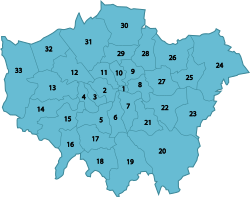  |
London's vast urban area is often described using a set of district names, such as Bloomsbury,Mayfair, Wembley andWhitechapel. These are either informal designations, reflect the names of villages that have been absorbed by sprawl, or are superseded administrative units such as parishes or former boroughs.
Such names have remained in use through tradition, each referring to a local area with its own distinctive character, but without current official boundaries. Since 1965 Greater London has been divided into 32 London boroughs in addition to the ancient City of London.[99][100] The City of London is the main financial district[101] and Canary Wharf has recently developed into a new financial and commercial hub, in the Docklands to the east.
The West End is London's main entertainment and shopping district, attracting tourists.[102] West London includes expensive residential areas where properties can sell for tens of millions of pounds.[103] The average price for properties in Kensington and Chelsea is £894,000 with similar average outlay in most of Central London.[104]
The East End is the area closest to the original Port of London, known for its high immigrant population, as well as for being one of the poorest areas in London.[105] The surrounding East London area saw much of London's early industrial development; now, brownfield sites throughout the area are being redeveloped as part of the Thames Gateway including the London Riverside and Lower Lea Valley, which is being developed into the Olympic Park for the 2012 Olympics and Paralympics.[105]
[edit]Architecture


London's buildings are too diverse to be characterised by any particular architectural style, and have been built over a long period of time. Many grand houses and public buildings, such as the National Gallery, are constructed from Portland stone. Some areas of the city, particularly those just west of the centre, are characterised by white stucco or whitewashed buildings. Few structures pre-date the Great Fire of 1666, except for a few trace Roman remains, the Tower of London and a few scattered Tudor survivors in the City. One notable building that remains from the Tudor period is Hampton Court Palace, which is England's oldest surviviving Tudor palace, built by Cardinal Thomas Wolsey circa 1515.[106] Wren's late 17th century churches and the financial institutions of the 18th and 19th centuries such as the Royal Exchange and the Bank of England, to the early 20th century Old Baileyand the 1960s Barbican Estate form part of the varied architectural heritage.
The disused, but soon to be rejuvenated, 1939 Battersea Power Station by the river in the southwest is a local landmark, while some railway termini are excellent examples of Victorian architecture, most notablySt. Pancras and Paddington.[107] The density of London varies, with high employment density in the central area, high residential densities in inner London and lower densities in the suburbs.
The Monument in the City of London provides views of the surrounding area while commemorating the Great Fire of London, which originated nearby. Marble Arch and Wellington Arch, at the north and south ends of Park Lane respectively, have royal connections, as do the Albert Memorial and Royal Albert Hall in Kensington. Nelson's Column is a nationally-recognised monument in Trafalgar Square, one of the focal points of the city centre.

High-rise development is restricted at certain sites if it would obstruct protected views of St Paul's Cathedral. Nevertheless, there are plans for more skyscrapers in Central London (see Tall buildings in London), including the 72-storey Shard London Bridge which is currently under construction. Development temporarily stalled as a result of the recent financial crisis, but is reported to be recovering.[108] Older buildings are mainly brick built, most commonly the yellowLondon stock brick or a warm orange-red variety, often decorated with carvings and white plastermouldings.[109]
In the dense areas, most of the concentration is achieved with medium- and high-rise buildings. London's skyscrapers such as 30 St Mary Axe, Tower 42, the Broadgate Tower and One Canada Square are usually found in the two financial districts, the City of London and Canary Wharf. Other notable modern buildings include City Hall in Southwark with its distinctive oval shape,[110] and theBritish Library in Somers Town/Kings Cross. What was formerly the Millennium Dome, located by the Thames to the east of Canary Wharf, is now used as an entertainment venue called The O2 Arena.
[edit]Parks and gardens

The largest parks in the central area of London are the Royal Parks of Hyde Park, its neighbourKensington Gardens at the western edge of Central London and Regent's Park on the northern edge.[111] Regent's Park contains London Zoo, the world's oldest scientific zoo, and is located near the tourist attraction of Madame Tussauds Wax Museum.[112][113]
Closer to central London are the smaller Royal Parks of Green Park and St. James's Park.[114]Hyde Park in particular is popular for sports and sometimes hosts open-air concerts. A number of large parks lie outside the city centre, including the remaining Royal Parks of Greenwich Park to the south-east[115] and Bushy Park and Richmond Park to the south-west,[116][117] as well asVictoria Park, East London to the east. Primrose Hill to the north of Regent's Park is a popular spot to view the city skyline.
Some more informal, semi-natural open spaces also exist, including the 320-hectare (790-acre)Hampstead Heath of North London.[118] This incorporates Kenwood House, the former stately home and a popular location in the summer months where classical musical concerts are held by the lake, attracting thousands of people every weekend to enjoy the music, scenery and fireworks.[119]
[edit]Demography
| 2001 United Kingdom Census[120] | |
|---|---|
| Country of birth | Population |
 United Kingdom United Kingdom | 5,230,155 |
 India India | 172,162 |
 Republic of Ireland Republic of Ireland | 157,285 |
 Bangladesh Bangladesh | 84,565 |
 Jamaica Jamaica | 80,319 |
 Nigeria Nigeria | 68,907 |
 Pakistan Pakistan | 66,658 |
 Kenya Kenya | 66,311 |
 Sri Lanka Sri Lanka | 49,932 |
 Ghana Ghana | 46,513 |
 Cyprus Cyprus | 45,888 |
 South Africa South Africa | 45,506 |
 United States United States | 44,622 |
 Australia Australia | 41,488 |
 Germany Germany | 39,818 |
 Turkey Turkey | 39,128 |
 Italy Italy | 38,694 |
 France France | 38,130 |
 Somalia Somalia | 33,831 |
 Uganda Uganda | 32,082 |
 New Zealand New Zealand | 27,494 |
| 2009–10 ONS estimates[121] | |
|---|---|
| Country of birth | Population |
| India | 248,000 |
 Poland Poland | 122,000 |
| Republic of Ireland | 110,000 |
| Bangladesh | 107,000 |
| Nigeria | 95,000 |
With increasing industrialisation, London's population grew rapidly throughout the 19th and early 20th centuries, and it was for some time in the late 19th and early 20th centuries the most populous city in the world until overtaken by New York in 1925. Its population peaked at 8,615,245 in 1939 immediately before the outbreak of the Second World War. There were an estimated 7,556,900 official residents in Greater London as of mid-2007.[122]
However, London's continuous urban area extends beyond the borders of Greater London and was home to 8,278,251 people in 2001,[20] while its wider metropolitan area has a population of between 12 and 14 million depending on the definition used.[123] According to Eurostat, London is the most populous city and metropolitan area of the European Union and the second most populous in Europe (or third if Istanbulis included). During the period 1991–2001 a net 726,000 immigrants arrived in London.[124]
The region covers an area of 1,579 square kilometres (610 sq mi). The population density is 4,542 inhabitants per square kilometre (11,760 /sq mi),[125] more than ten times that of any other British region.[126] In terms of population, London is the 25th largest city and the 18th largest metropolitan region in the world. It is also ranked 4th in the world in number of billionaires (United States Dollars) residing in the city.[127] London ranks as one of the most expensive cities in the world, alongside Tokyo and Moscow.[128]
[edit]Ethnic groups
According to the Office for National Statistics, based on 2007 estimates, 69.0 per cent of the 7.5 million inhabitants of London were White, with 57.7 per cent White British, 2.4 per cent White Irish and 8.9 per cent classified as Other White. Some 13.3 per cent are of South Asian descent, with Indians making up 6.6 per cent of London's population, followed by Pakistanis and Bangladeshis at 2.4 per cent and 2.3 per cent respectively. 2.0 per cent are categorised as "Other Asian". 10.6 per cent of London's population areBlack, with around 5.5 per cent being Black African, 4.3 per cent as Black Caribbean and 0.8 per cent as "Other Black". 3.5 per cent of Londoners are of mixed race; 1.5 per cent are Chinese; and 2.0 per cent belong to another ethnic group.[3] The non-white ethnic minority population of London in 2001 was just over 2 million or 29 per cent: an increase of 722,000 from 1991.[129]
Across London, Black and Asian children outnumber White British children by about six to four in state schools.[130] In January 2005, a survey of London's ethnic and religious diversity claimed that there were more than 300 languages spoken and more than 50 non-indigenous communities which have a population of more than 10,000 in London.[131] Figures from the Office for National Statistics show that, as of 2010, London's foreign-born population is 2,650,000 (33 per cent), up from 1,630,000 in 1997.
The 2001 census showed that 27.1 per cent of Greater London's population were born outside the UK.[132] The table to the right shows the 20 most common foreign countries of birth of London residents in 2001, the date of the last published UK Census.[120] A portion of the German-born population are likely to be British nationals born to parents serving in the British Armed Forces in Germany.[133] Estimates produced by the Office for National Statistics indicate that the five largest foreign-born groups living in London in the period July 2009 to June 2010 were those born in India, Poland, the Republic of Ireland, Bangladesh and Nigeria.[121]
[edit]Religion
The majority of Londoners – 58.2 per cent – identify themselves as Christians.[134] This is followed by those of no religion (15.8 per cent), Muslims (8.5 per cent), Hindus (4.1 per cent), Jews (2.1 per cent), Sikhs (1.5 per cent), Buddhists (0.8 per cent) and other (0.2 per cent), though 8.7 per cent of people did not answer this question in the 2001 Census.[134]
London has traditionally been Christian, and has a large number of churches, particularly in the City of London. The well-known St Paul's Cathedral in the City and Southwark Cathedral south of the river are Anglican administrative centres,[135] while the Archbishop of Canterbury, principal bishop of the Church of England and worldwide Anglican Communion, has his main residence at Lambeth Palace in the London Borough of Lambeth.[136]

Important national and royal ceremonies are shared between St Paul's and Westminster Abbey.[137] The Abbey is not to be confused with nearby Westminster Cathedral, which is the largest Roman Catholic cathedral in England and Wales.[138] Despite the prevalence of Anglican churches, observance is very low within the Anglican denomination. Church attendance continues on a long, slow, steady decline, according to Church of England statistics.[139]
London is also home to sizeable Muslim, Hindu, Sikh, and Jewish communities. Many Muslims live in Tower Hamlets and Newham; the most important Muslim edifice is London Central Mosqueon the edge of Regent's Park.[140] Following the oil boom, increasing numbers of wealthy Middle-Eastern Muslims have based themselves around Mayfair and Knightsbridge in west London.[141][142] London is home to the largest mosque in western Europe, the Baitul FutuhMosque, of the Ahmadiyya Muslim Community.
London's large Hindu community is found in the north-western boroughs of Harrow and Brent, the latter of which is home to one of Europe's largest Hindu temples, Neasden Temple.[143] Sikh communities are located in East and West London, which is also home to the largest Sikh temple in the world outside India.[144]
The majority of British Jews live in London, with significant Jewish communities in Stamford Hill, Stanmore, Golders Green, Hampstead,Hendon and Edgware in North London.[citation needed] Stanmore and Canons Park Synagogue has the largest membership of any single Orthodox synagogue in the whole of Europe, overtaking Ilford synagogue (also in London) in 1998.[145] The community set up the London Jewish Forum in 2006 in response to the growing significance of devolved London Government.[146]
[edit]Economy

London generates approximately 20 per cent of the UK's GDP[147] (or $446 billion in 2005); while the economy of the London metropolitan area—the largest in Europe—generates approximately 30 per cent of the UK's GDP (or an estimated $669 billion in 2005).[148] London is one of the pre-eminent financial centres of the world and vies with New York City as the most important location for international finance.[149][150]
London's largest industry is finance, and its financial exports make it a large contributor to the UK's balance of payments. Around 325,000 people were employed in financial services in London until mid-2007. London has over 480 overseas banks, more than any other city in the world. Currently, over 85% (3.2 million) of the employed population of greater London works in the services industries. Due to its prominent global role, London's economy has been affected by thelate-2000s financial crisis. The City of London estimates that 70,000 jobs in finance will be cut within a year.[151] The City of London is home to the Bank of England, London Stock Exchange, and Lloyd's of London insurance market.
Over half of the UK's top 100 listed companies (the FTSE 100) and over 100 of Europe's 500 largest companies are headquartered in Central London. Over 70 per cent of the FTSE 100 are located within London's metropolitan area, and 75 per cent of Fortune 500 companies have offices in London.[152]

Along with professional services, media companies are concentrated in London and the media distribution industry is London's second most competitive sector.[153] The BBC is a significant employer, while other broadcasters also have headquarters around the City. Many national newspapers are edited in London. London is a major retail centre and in 2010 had the highest non-food retail sales of any city in the world, with a total spend of around £64.2 billion.[154] The Port of London is the second-largest in the United Kingdom, handling 45 million tonnes of cargo each year.[155]
London has five major business districts: the City, Westminster, Canary Wharf, Camden & Islington and Lambeth & Southwark. One way to get an idea of their relative importance is to look at relative amounts of office space: Greater London had 26,721,000 m2 of office space in 2001, and the City contains the most space, with over 7.7 million m2 of office space.[citation needed]
[edit]Tourism

Tourism is one of London's prime industries and employs the equivalent of 350,000 full-time workers in London in 2003,[156] while annual expenditure by tourists is around £15 billion.[157] London attracts over 14 million international visitors per year, making it the world's most visited city.[14] London attracts 27 million overnight-stay visitors every year.[158]
In 2009 the ten most-visited attractions in London were:[159]
- British Museum
- National Gallery
- Tate Modern
- Natural History Museum
- London Eye
- Science Museum
- Tower of London
- National Maritime Museum
- Victoria and Albert Museum
- Madame Tussauds
[edit]Transport
Transport is one of the four main areas of policy administered by the Mayor of London,[160] however the mayor's financial control does not extend to the longer distance rail network that enters London. In 2007 he assumed responsibility for some local lines, which now form theLondon Overground network, adding to the existing responsibility for the London Underground, trams and buses. The public transport network is administered by Transport for London (TfL) and is one of the most extensive in the world. Cycling is an increasingly popular way to get around London. The London Cycling Campaign lobbies for better provision.[161]
The lines that formed the London Underground, as well as trams and buses, became part of an integrated transport system in 1933 when theLondon Passenger Transport Board (LPTB) or London Transport was created. Transport for London (TfL), is now the statutory corporation responsible for most aspects of the transport system in Greater London, and is run by a board and a commissioner appointed by the Mayor of London.[162]
[edit]Air

London is a major international air transport hub with the largest city airspace in the world. Eight airports use the word London in their name, but most traffic passes through only five. London Heathrow Airport, in Hillingdon, West London, is the busiest airport in the world for international traffic, and is the major hub of the nation's flag carrier, British Airways.[164] In March 2008 its fifth terminal was opened.[165] There were plans for a third runway and a sixth terminal however these were cancelled by the Coalition Government on 12 May 2010.[166] Similar traffic, with the addition of some low-cost short-haul flights, is also handled at London Gatwick Airport, located south of London in West Sussex.[167]
Stansted Airport, situated north east of London in Essex, is the main UK hub for Ryanair andLuton Airport to the north of London in Bedfordshire, caters mostly for low-cost short-haul flights.[168][169] London City Airport, the smallest and most central airport, is focused on business travellers, with a mixture of full service short-haul scheduled flights and considerable business jet traffic.[170]
[edit]Buses and trams
_and_Routemaster_RM54_(LDS_279A)_route_159.jpg)

London's bus network is one of the largest in the world, running 24 hours a day, with 8,000 buses, 700 bus routes, and over 6 million passenger journeys made every weekday. In 2003, the network's ridership was estimated at over 1.5 billion passenger trips per annum, more than the Underground.[171] Around £850 million is taken in revenue each year. London has the largest wheelchair accessible network in the world[172] and, from the 3rd quarter of 2007, became more accessible to hearing and visually impaired passengers as audio-visual announcements were introduced. The distinctive red double-decker buses are internationally recognised, and are a trademark of London transport along with black cabs and the Tube.[173][174]
London has a modern tram network, known as Tramlink, based in Croydon in South London. The network has 39 stops, three routes and carried 26.5 million people in 2008. Since June 2008Transport for London has completely owned Tramlink and plans to spend £54m by 2015 on maintenance, renewals, upgrades and capacity enhancements. Since April 2009 all trams have been refurbished.[175]
[edit]Cycling
Cycling in London has enjoyed a renaissance since the turn of the Millennium. Cyclists enjoy a cheaper, and often quicker, way around town than those by public transport or car, and the launch of the Barclays Cycle Hire scheme in July 2010 has been successful and generally well-received.
[edit]Port
From being the largest port in the world, the Port of London is now only the second-largest in the United Kingdom, handling 45 million tonnes of cargo each year.[155] Most of this actually passes through the Port of Tilbury, outside the boundary of Greater London.
[edit]Rail

The London Underground — all of which is now commonly referred to as the Tube, though originally this designation referred only to the deep-level lines, as distinct from the sub-surface lines — is the oldest,[27] and second longest[28] metro system in the world, dating from 1863. The system serves 270 stations[176] and was formed from several private companies, including the world's first underground electric line, the City and South London Railway.[177]
Over three million journeys are made every day on the Underground network, over 1 billion each year.[178] An investment programme is attempting to address congestion and reliability problems, including £7 billion (€10 billion) of improvements planned for the 2012 Summer Olympics.[179]London has been commended as the city with the best public transport.[180] The Docklands Light Railway, which opened in 1987, is a second, more local metro system using smaller and lighter tram-type vehicles which serve Docklands and Greenwich.
There is an extensive above-ground suburban railway network, particularly in South London, which has fewer Underground lines. London houses Britain's busiest station – Waterloo with over 184 million people using the interchange station complex (which includes Waterloo East station) each year. The stations have services to South East and South West London, and also parts of South East and South West England.[181][182] Most rail lines terminate around the centre of London, running into eighteen terminal stations with the exception of the Thameslink trains connecting Bedford in the north and Brighton in the south via Luton and Gatwickairports.[183]
Since 2007 high-speed Eurostar trains link St. Pancras International with Lille, Paris, and Brussels. Journey times to Paris and Brussels of two-and-a-quarter hours and one hour 50 minutes respectively make London closer to continental Europe than the rest of Britain by virtue of the High Speed 1 rail link to the Channel Tunnel[184] while the first high speed domestic trains started in June 2009 linking Kent to London.[185]
[edit]Roads

Although the majority of journeys involving Central London are made by public transport, car travel is common in the suburbs. The inner ring road (around the city centre), the North and South Circular roads (in the suburbs), and the outer orbital motorway (the M25, outside the built-up area) encircle the city and are intersected by a number of busy radial routes—but very few motorways penetrate into inner London. The M25 is the longest ring-road motorway in the world at 195.5 km (121.5 mi) long.[186] The A1 and M1 connect London to Edinburgh, Leeds and Newcastle.
A plan for a comprehensive network of motorways throughout the city (the Ringways Plan) was prepared in the 1960s but was mostly cancelled in the early 1970s. In 2003, a congestion chargewas introduced to reduce traffic volumes in the city centre. With a few exceptions, motorists are required to pay £8 per day to drive within a defined zone encompassing much of congested Central London.[187][188] Motorists who are residents of the defined zone can buy a vastly reduced season pass which is renewed monthly and is cheaper than a corresponding bus fare.[189] London is notorious for its traffic congestion, with the M25 motorway the busiest stretch in the country. The average speed of a car in the rush hour is 10.6 mph (17.1 km/h).[190]
[edit]Education
[edit]Tertiary education
.jpg)
London is a major centre of higher education teaching and research and its 43 universities form the largest concentration of higher education in Europe.[16] In 2008/09 it had a higher education student population of around 412,000 (approximately 17 per cent of the UK total), of whom around 287,000 were registered for undergraduate degrees and 118,000 were studying at postgraduate level.[191] In 2008/09 there were around 97,150 international students in London, approximately 25 per cent of all international students in the UK.[191]
A number of world-leading education institutions are based in London. In the 2010 QS World University Rankings, University College London (UCL) is ranked 4th, Imperial College London 7th and King's College London 21st in the world.[192] The London School of Economics has been described as the world's leading social science institution for both teaching and research.[193] TheLondon Business School is considered one of the world's leading business schools and in 2010 its MBA programme was ranked best in the world by the Financial Times.[194]
With 125,000 students, the federal University of London is the largest contact teaching university in Europe.[195] It includes four large multi-faculty universities – King's College London, Queen Mary, Royal Holloway and UCL – and a number of smaller and more specialised institutions including Birkbeck, the Courtauld Institute of Art, Goldsmiths, Guildhall School of Music and Drama, the Institute of Education, the London Business School, the London School of Economics, the London School of Hygiene & Tropical Medicine, the Royal Academy of Music, the Royal Veterinary College, The School of Pharmacy and the School of Oriental and African Studies.[196] Members of the University of London have their own admissions procedures, and some award their own degrees.
There are a number of universities in London which are outside of the University of London system, including Brunel University, City University London, Imperial College London, Kingston University, London Metropolitan University (with over 34,000 students, the largest unitary university in London),[197] London South Bank University, Middlesex University, University of the Arts London (the largest university of art, design, fashion, communication and the performing arts in Europe),[198] University of East London, the University of West London and theUniversity of Westminster. In addition there are three international universities in London – Regent's College, Richmond University and Schiller International University.

London is home to five major medical schools – Barts and The London School of Medicine and Dentistry (part of Queen Mary), King's College London School of Medicine and Dentistry (the largest medical school in Europe), Imperial College School of Medicine, UCL Medical School andSt George's, University of London – and has a large number of affiliated teaching hospitals. It is also a major centre for biomedical research, and three of the UK's five academic health science centres are based in the city – Imperial College Healthcare, King's Health Partners and UCL Partners (the largest such centre in Europe).[199] There are a number of business schools in London, including Cass Business School (part of City University London), ESCP Europe,European Business School London, Imperial College Business School and the London Business School. London is also home to many specialist arts education institutions, including theAcademy of Live and Recorded Arts, the London Contemporary Dance School, RADA, the Royal College of Art, the Royal College of Music and Trinity Laban.
[edit]Primary and secondary education
The majority of primary and secondary schools in London are state schools and are controlled by the London boroughs, although there are also a number of private schools in London, including old and famous schools such as the City of London School, Harrow, St Paul's School,University College School, Highgate School and Westminster School.
[edit]Culture
[edit]Accent
The London accent long ago acquired the Cockney label, and was similar to many accents of the South East of England. The accent of a 21st century 'Londoner' varies widely; what is becoming more and more common amongst the under 30s however is some fusion of Cockney,Received Pronunciation, and a whole array of 'ethnic' accents, in particular Caribbean, which form an accent labelled Multicultural London English (MLE).[200]
[edit]Leisure and entertainment

Within the City of Westminster, the entertainment district of the West End has its focus aroundLeicester Square, where London and world film premieres are held, and Piccadilly Circus, with its giant electronic advertisements.[201] London's theatre district is here, as are many cinemas, bars, clubs and restaurants, including the city's Chinatown district (in Soho), and just to the east isCovent Garden, an area housing speciality shops. The United Kingdom's Royal Ballet, English National Ballet, Royal Opera and English National Opera are based in London and perform at theRoyal Opera House, the London Coliseum, Sadler's Wells Theatre and the Royal Albert Hall as well as touring the country.[202]

Islington's 1 mile (1.6 km) long Upper Street, extending northwards from the Angel, has more bars and restaurants than any other street in the UK.[203]Europe's busiest shopping area is Oxford Street, a shopping street nearly 1 mile (1.6 km) long—which makes it the longest shopping street in the UK and home to many shops and department stores including Selfridges.[204] Knightsbridge—home to the Harrods department store—lies just to the southwest.
London is home to designers Vivienne Westwood, Galliano, Stella McCartney, Manolo Blahnik, and Jimmy Choo among others; its renowned art and fashion schools make it an international centre of fashion alongside Paris, Milan and New York. London offers a great variety of cuisine as a result of its ethnically diverse population. Gastronomic centres include the Bangladeshirestaurants of Brick Lane and the Chinese food restaurants of Chinatown.[205]
There are a variety of regular annual events in the city. The beginning of the year is celebrated with the relatively new New Year's Day Parade, fireworks display at the London Eye, and the world's second largest street party, the Notting Hill Carnival is held during the late August Bank holiday each year. Traditional parades include November's Lord Mayor's Show, a centuries-old event celebrating the annual appointment of a new Lord Mayor of the City of London with a procession along the streets of the City, and June's Trooping the Colour, a formal military pageant performed by regiments of the Commonwealth and British armies to celebrate the Queen's Official Birthday.[206]
[edit]Literature, film and television

London has been the setting for many works of literature. The literary centres of London have traditionally been hilly Hampstead and (since the early 20th century) Bloomsbury. Writers closely associated with the city are the diarist Samuel Pepys, noted for his eyewitness account of theGreat Fire, Charles Dickens, whose representation of a foggy, snowy, grimy London of street sweepers and pickpockets has been a major influence on people's vision of early VictorianLondon, and Virginia Woolf, regarded as one of the foremost modernist literary figures of the 20th century.[207]
The pilgrims in Geoffrey Chaucer's late 14th-century Canterbury Tales set out for Canterbury from London – specifically, from the Tabard inn, Southwark. William Shakespeare spent a large part of his life living and working in London; his contemporary Ben Jonson was also based there, and some of his work—most notably his play The Alchemist—was set in the city.[207] A Journal of the Plague Year (1722) by Daniel Defoe is a fictionalisation of the events of the 1665 Great Plague.[207] Later important depictions of London from the 19th and early 20th centuries are Dickens' novels, and Arthur Conan Doyle's Sherlock Holmes stories.[207] Modern writers pervasively influenced by the city include Peter Ackroyd, author of a "biography" of London, and Iain Sinclair, who writes in the genre ofpsychogeography.
London was the setting for the films Oliver Twist (1948), Peter Pan (1953), The Ladykillers (1955), The 101 Dalmatians (1961), Mary Poppins(1964), Blowup (1966), The Long Good Friday (1980), Secrets & Lies (1996), Notting Hill (1999), Match Point (2005), V For Vendetta (2005) and Sweeney Todd: The Demon Barber Of Fleet Street (2008). The television soap opera EastEnders, first broadcast in 1985, is also set in the city. London has played a significant role in the film industry, and has major studios at Ealing and a special effects and post-productioncommunity centred in Soho. Working Title Films has its headquarters in London.[208]
[edit]Museums and art galleries

London is home to many museums, galleries, and other institutions, many of which are free of admission charges and are major tourist attractions as well as playing a research role. The first of these to be established was the British Museum in Bloomsbury, in 1753. Originally containing antiquities, natural history specimens and the national library, the museum now has 7 million artefacts from around the globe. In 1824 the National Gallery was founded to house the British national collection of Western paintings; this now occupies a prominent position in Trafalgar Square. In the latter half of the nineteenth century the locale of South Kensington was developed as "Albertopolis", a cultural and scientific quarter. Three major national museums are located there: the Victoria and Albert Museum (for the applied arts), the Natural History Museum and theScience Museum. The national gallery of British art is at Tate Britain, originally established as an annexe of the National Gallery in 1897. The Tate Gallery, as it was formerly known, also became a major centre for modern art; in 2000 this collection moved to Tate Modern, a new gallery housed in the former Bankside Power Station.
[edit]Music

London is one of the major classical and popular music capitals of the world and is home to major music corporations, such as EMI, as well as countless bands, musicians and industry professionals. The city is also home to many orchestras and concert halls, such as the Barbican Arts Centre (principal base of the London Symphony Orchestra), Cadogan Hall (Royal Philharmonic Orchestra) and the Royal Albert Hall (The Proms).[202] London's two main opera houses are the Royal Opera House and the Coliseum Theatre.[202] The UK's largest pipe organcan be found at the Royal Albert Hall. Other significant instruments are found at the cathedrals and major churches. Several conservatoires are located within the city: Royal Academy of Music,Royal College of Music, Guildhall School of Music and Drama and Trinity College of Music.

London has numerous venues for rock and pop concerts, including large arenas such as Earls Court,Wembley Arena and the O2 Arena, as well as many mid-sized venues, such as Brixton Academy,Hammersmith Apollo and the Shepherd's Bush Empire.[202] Several music festivals, including theWireless Festival, are held in London. The city is home to the first and original Hard Rock Cafeand the Abbey Road Studios where The Beatles recorded many of their hits. In the 1970s and 1980s, musicians and groups like David Bowie, Queen, Elvis Costello, Cat Stevens, Ian Dury and the Blockheads, The Kinks, The Rolling Stones, The Who, Madness, The Jam, The Small Faces,Led Zeppelin, Iron Maiden, Fleetwood Mac, The Police, The Cure, Squeeze and Sade, took the world by storm, deriving their sound from the streets and rhythms vibrating through London.[209]
London was instrumental in the development of punk music,[210] with figures such as the Sex Pistols, The Clash,[209] and Vivienne Westwood all based in the city. More recent artists to emerge from the London music scene include Bananarama, Wham!, The Escape Club, Bush, East 17, Siouxsie and the Banshees, theSpice Girls, Jamiroquai, The Libertines, Babyshambles, Bloc Party, Amy Winehouse, Coldplay and, most famously, George Michael.[211]London is also a centre for urban music. In particular the genres UK garage, drum and bass, dubstep and grime evolved in the city from the foreign genres of hip hop and reggae, alongside local drum and bass. Black music station BBC 1Xtra was set up to support the rise of homegrown urban music both in London and the rest of the UK.
In the 1980s London was the main city in the New Wave of British Heavy Metal era which made bands like Iron Maiden and Motörheadfamous worldwide. During the same decade, the city became influential in the New Wave and New Romantic movements, providing the background for acts like Culture Club, the Pet Shop Boys and Spandau Ballet.
[edit]Sports

London has hosted the Summer Olympics twice, in 1908 and 1948.[212][213] In July 2005 London was chosen to host the Olympic and Paralympic Games in 2012, which will make it the first city in the world to host the Summer Olympics three times.[17] London was also the host of the British Empire Games in 1934.[214] London's most popular sport is football and it has fourteen Leaguefootball clubs, including five in the Premier League: Arsenal, Chelsea, Fulham, Queens Park Rangers and Tottenham Hotspur.[215]
London also has four rugby union teams in the Aviva Premiership (London Irish, Saracens, Waspsand Harlequins), although only the Harlequins play in London (all the other three now play outside Greater London, although Saracens still play within the M25).[216] The other professional rugby union team in the city is second division club London Welsh, that plays home matches in the city. The city has other very traditional rugby union clubs, famously London Scottish, Richmond F.C.,Rosslyn Park F.C., Westcombe Park R.F.C. and Blackheath F.C..
There are currently two professional rugby league clubs in London – Harlequins Rugby League who play in the European Super League at The Stoop and the Championship One side the London Skolars (based in Wood Green, London Borough of Haringey). Numbers for juniors playing the sport in the city are at an all time high with several earning full England caps at international level. In November 2011 Wembley Stadiumwill host a Gillette 4 Nations double-header including England v Australia and Wales v New Zealand.

From 1924, the original Wembley Stadium was the home of the English national football team, and served as the venue for the FA Cup final as well as rugby league's Challenge Cup final.[217] The new Wembley Stadium serves exactly the same purposes and has a capacity of 90,000.[218]Twickenham Stadium in south-west London is the national rugby union stadium, and has a capacity of 84,000 now that the new south stand has been completed.[219]
Cricket in London is served by two Test cricket grounds Lord's (home of Middlesex C.C.C) in St John's Wood[220] and the Oval (home of Surrey C.C.C) in Kennington.[221] Lord's has hosted four finals of the cricket world cups. One of London's best-known annual sports competitions is theWimbledon Tennis Championships, held at the All England Club in the south-western suburb ofWimbledon.[222] Other key events are the annual mass-participation London Marathon which sees some 35,000 runners attempt a 26.2 miles (42.2 km) course around the city,[223] and the Oxford and Cambridge Boat Race on the River Thames between Putney and Mortlake.[224]
[edit]Twin cities
There are 46 other places on six continents named after London.[225] As well as London's twinning, the London boroughs have twinnings with parts of other cities across the world. Shown below is the list of cities that the Greater London Authority has twinning arrangements with:


The following cities have a friendship agreement with London:


[edit]See also


[edit]Notes
- ^ According to the European Statistical Agency, London is the largest Larger Urban Zone which uses conurbations and areas of high population as its definition. A ranking of population within municipal boundaries places London first. However, the University of Avignon in France claims that Paris is first and London second when including the whole urban area and hinterland, that is theoutlying cities as well.
- ^ See also: Independent city#National capitals.
- ^ According to the Collins English Dictionary definition of 'the seat of government',[86] London is not the capital of England, as England does not have its own government. According to theOxford English Reference Dictionary definition of 'the most important town'[87] and many other authorities.[88]
[edit]References
- ^ (online) London, United Kingdom Forecast : Weather Underground (weather and elevation at Heathrow Airport). The Weather Underground, Inc.. Archived from the original on 2011-05-19. Retrieved 6 June 2008.
- ^ a b July 2010 Population estimates for UK, England and Wales, Scotland and Northern Ireland. Office for National Statistics. Retrieved 3 July 2011.
- ^ a b "Resident Population Estimates by Ethnic Group (Percentages)". Neighbourhood Statistics. Office for National Statistics. Archived from the original on 2011-05-19. Retrieved 31 July 2010.
- ^ "Roman". The Museum of London. Retrieved 7 June 2008.
- ^ a b Mills 2001, p. 140
- ^ a b "Government Offices for the English Regions, Fact Files: London". Office for National Statistics. Retrieved 4 May 2008.[dead link]
- ^ Elcock, Howard (1994). Local Government: Policy and Management in Local Authorities. Routledge. p. 368. ISBN 978-0-415-10167-7.
- ^ Jones, Bill; Kavanagh, Dennis; Moran, Michael; Norton, Philip (2007). Politics UK. Pearson Education. p. 868. ISBN 978-1-4058-2411-8.
- ^ "Global Power City Index 2009". Institute for Urban Strategies – The Mori Memorial Foundation. Retrieved 14 December 2010.
- ^ "Global Financial Centres 9". Z/Yen. 2011.
- ^ a b ""World's Most Economically Powerful Cities".". Forbes. 15 July 2008. Archived from the original on 2011-05-19. Retrieved 3 October 2010.
- ^ a b "Worldwide Centres of Commerce Index 2008". Mastercard.
- ^ "Global city GDP rankings 2008–2025". PricewaterhouseCoopers. Archived from the original on 2011-05-19. Retrieved 16 November 2010.
- ^ a b "Euromonitor International's Top City Destination Ranking (2011 update)". Euromonitor International. 6 January 2011.Archived from the original on 2011-08-08. Retrieved 08 August 2011.
- ^ a b "Delta Expects New Slots To Foster Growth At Heathrow Airport". The Wall Street Journal. 23 February 2011. Archivedfrom the original on 2011-05-19. Retrieved 7 March 2011.
- ^ a b "Number of international students in London continues to grow". Greater London Authority. Archived from the original on 2011-05-19. Retrieved 27 August 2010.
- ^ a b "IOC elects London as the Host City of the Games of the XXX Olympiad in 2012". International Olympic Committee. 6 July 2005. Retrieved 3 June 2006.
- ^ "Languages spoken in the UK population". CILT, the National Centre for Language. Archived from the original on 2011-05-19. Retrieved 6 June 2008.
- ^ "Largest EU City. Over 7 million residents in 2001".www.statistics.gov.uk. Office for National Statistics. Archived from the original on 2007-07-26. Retrieved 28 June 2008.
- ^ a b "KS01 Usual resident population: Census 2001, Key Statistics for urban areas". Office for National Statistics. Archived from the original on 2011-05-19. Retrieved 6 June 2008.
- ^ "The Principal Agglomerations of the World". City Population.Archived from the original on 2010-07-23. Retrieved 3 March 2009.
- ^ "Southest England Population by Area from 1891".Demographia. Archived from the original on 2011-05-19. Retrieved 1 April 2009.
- ^ a b "London: The greatest city". Channel4.com. Archived from the original on 2011-05-19. Retrieved 12 October 2008.
- ^ "Lists: United Kingdom of Great Britain and Northern Ireland".UNESCO. Retrieved 26 November 2008.
- ^ "West End Must Innovate to Renovate, Says Report". What's On Stage. 25 January 2008. Archived from the original on 2011-05-19. Retrieved 15 November 2010.
- ^ "Chinatown Action Plan". Westminster Council. Retrieved 9 October 2010.
- ^ a b Transport for London. London Underground: History.ISBN 978-0-904711-30-1. Retrieved 6 June 2008. Archived 19 May 2011 at WebCite
- ^ a b "Shanghai now the world's longest metro". Railway Gazette International. 4 May 2010. Archived from the original on 2011-05-19. Retrieved 4 May 2010.
- ^ a b c d Mills 2001, p. 139
- ^ Ackroyd, Peter (2 December 2001). "'London'". New York Times. ISBN 978-0-7011-7279-4. Retrieved 28 October 2008.
- ^ Coates, Richard (1998). "A new explanation of the name of London". Transactions of the Philological Society 96 (2): 203–229. doi:10.1111/1467-968X.00027. Archived from the original on 2011-05-19.
- ^ Perring, Dominic (1991). Roman London. London: Routledge. p. 1. ISBN 978-0-203-23133-3.
- ^ "British History Timeline —Roman Britain". British Broadcasting Corporation. Archived from the original on 2011-05-19. Retrieved 7 June 2008.
- ^ a b "The early years of Lundenwic". The Museum of London. Retrieved 7 June 2008.[dead link]
- ^ a b "Viking and Danish London". The Museum of London. Retrieved 6 June 2008.[dead link]
- ^ "Medieval London —Vikings". The Museum of London. Retrieved 7 June 2008.
- ^ George Hamilton Cunningham (1927). London. J. M. Dent & Sons. p. xiii.
- ^ Denison, Simon (July 1999). "First `London Bridge' in River Thames at Vauxhall". British Archaeology (46). Archived from the original on 2011-05-19. Retrieved 15 April 2011.
- ^ Milne, Gustav. "London's Oldest Foreshore Structure!". Frog Blog. Thames Discovery Programme. Archived from the original on 2011-05-19. Retrieved 15 April 2011.
- ^ "Edward the Confessor (c.1003–1066)". British Broadcasting Corporation. Archived from the original on 2011-05-19. Retrieved 27 September 2008.
- ^ "History – 1066 – King William". BBC. Archived from the original on 2011-05-19. Retrieved 5 May 2008.
- ^ Tinniswood, Adrian. "A History of British Architecture — White Tower". BBC. Archived from the original on 2011-05-19. Retrieved 5 May 2008.
- ^ "UK Parliament — Parliament: The building". UK Parliament. 9 November 2007. Archived from the original on 11 March 2008. Retrieved 27 April 2008.
- ^ "Palace of Westminster". UK Parliament. Archived from the original on 4 April 2008. Retrieved 27 April 2008.
- ^ Schofield, John; Vince, Alan (2003). Medieval Towns: The Archaeology of British Towns in Their European Setting. Continuum International Publishing Group. p. 26. ISBN 978-0-8264-6002-8.
- ^ BBC – History – Black Death. BBC News. Retrieved 3 November 2008.
- ^ "Richard II (1367–1400)". BBC. Archived from the original on 2011-05-19. Retrieved 12 October 2008.
- ^ a b Nikolaus Pevsner, London I: The Cities of London and Westminster rev. edition,1962, Introduction p 48.
- ^ Durston, Christopher (1993). James I. London: Routledge. p. 59.ISBN 978-0-415-07779-8.
- ^ "A List of National Epidemics of Plague in England 1348–1665". Urbanrim.org.uk. 4 December 2009. Archived from the original on 2009-05-03. Retrieved 3 May 2010.
- ^ Story of the plague. Channel 4. Archived 19 May 2011 atWebCite
- ^ Pepys, Samuel (September 2, 1666) [1893]. The Diary of Samuel Pepys. 45: August/September 1666. ISBN 978-0-520-22167-3. Archived from the original on 2011-05-19.
- ^ Schofield J (January 2001). "London After the Great Fire: Civil War and Revolution". BBC. Archived from the original on 2011-05-19. Retrieved 28 April 2008.
- ^ "Museum of London — Rebuilding after the fire". Museum of London. Archived from the original on 1 February 2008. Retrieved 27 April 2008.
- ^ The Rebuilding of London After the Great Fire. Thomas Fiddian. 1940. Retrieved 27 April 2008.
- ^ The curious life of Robert Hooke, the man who measured London by Lisa Jardine
- ^ "Thief Taker, Constable, Police". Public Broadcasting Service (PBS). Archived 19 May 2011 at WebCite
- ^ "Rough justice – Victorian style". BBC News. 3 August 2009.Archived 19 May 2011 at WebCite
- ^ National Affairs: Capital punishment: a fading practice. TIME. 21 March 1960. Archived 19 May 2011 at WebCite
- ^ BBC – History – The Foundling Hospital. Published: 1 May 2001. Archived 19 May 2011 at WebCite
- ^ "When a man is tired of London, he is tired of life: Samuel Johnson". Archived from the original on 2011-05-19.
- ^ "Hidden extras: cholera comes to Victorian London". Science Museum. Archived 19 May 2011 at WebCite
- ^ "London in the Nineteenth Century". The University of North Carolina and Pembroke. Archived 19 May 2011 at WebCite
- ^ 7 July Bombings: Overview. London: BBC News. Archivedfrom the original on 2007-02-13. Retrieved 28 April 2008.
- ^ "About the Greater London Authority". London Government.Archived from the original on 2011-05-19. Retrieved 27 September 2008.
- ^ "Links to other websites — London boroughs". London Government. Archived from the original on 19 October 2007. Retrieved 27 September 2008.
- ^ "Policing". Greater London Authority. Archived from the original on 21 January 2008. Retrieved 25 August 2009.
- ^ "Areas". British Transport Police. Archived from the original on 2011-05-19. Retrieved 25 August 2009.
- ^ "Who we are". London Fire Brigade. Archived from the original on 2011-05-19. Retrieved 25 August 2009.
- ^ "About us". London Ambulance Service NHS Trust. Archivedfrom the original on 2011-05-19. Retrieved 25 August 2009.
- ^ "Station list". Maritime and Coastguard Agency. 2007.Archived from the original on 2011-05-19. Retrieved 25 August 2009.
- ^ "Thames lifeboat service launched". BBC News. 2 January 2002. Archived from the original on 2011-05-19. Retrieved 25 August 2009.
- ^ "10 Downing Street — Official Website". 10 Downing Street. Archived from the original on 10 May 2008. Retrieved 26 April 2008.
- ^ "UK Politics: Talking Politics — The 'Mother of Parliaments'". BBC. 3 June 1998. Archived from the original on 2011-05-19. Retrieved 6 June 2008.
- ^ Beavan, Charles; Bickersteth, Harry (1865). Reports of Cases in Chancery, Argued and Determined in the Rolls Court. Saunders and Benning.
- ^ Stationery Office (1980). The Inner London Letter Post. H.M.S.O. p. 128. ISBN 978-0-10-251580-0.
- ^ Geographers' A-Z Map Company (2008). London Postcode and Administrative Boundaries (6 ed.). Geographers' A-Z Map Company. ISBN 978-1-84348-592-6.
- ^ Mail, Royal (2004). Address Management Guide. Royal Mail.
- ^ "The Essex, Greater London and Hertfordshire (County and London Borough Boundaries) Order". Office of Public Sector Information. 1993. Archived from the original on 2011-05-19. Retrieved 6 June 2008.
- ^ Dilys, M Hill (2000). Urban Policy and Politics in Britain. St. Martin's Press. p. 268. ISBN 978-0-312-22745-6.
- ^ "London in its Regional Setting (PDF)" (PDF). London Assembly. Archived from the original on 27 May 2008. Retrieved 6 June 2008.
- ^ London Government Act 1963. Office of Public Sector Information. ISBN 978-0-16-053895-7. Archived from the originalon 2011-05-19. Retrieved 6 May 2008.
- ^ "London — Features — Where is the Centre of London?". BBC. Archived from the original on 2010-01-18. Retrieved 6 June 2008.
- ^ "Lieutenancies Act 1997". OPSI. Archived from the original on 2011-05-19. Retrieved 7 June 2008.
- ^ Barlow, I. M. (1991). Metropolitan Government. Routledge. p. 346.ISBN Routledge.
- ^ (1994) Collins English Dictionary, Collins Education plc.
- ^ Oxford English Reference Dictionary, Oxford English.
- ^ "HC 501 0304.PDF" (PDF). Parliament Publications
- ^ Schofield, John (June 1999). British Archaeology Issue 45, June 1999. British Archaeology. ISSN 1357-4442. Archived from the original on 2011-05-19. Retrieved 6 May 2008.
- ^ "Metropolis: 027 London, World Association of the Major Metropolises". Retrieved 3 May 2010.
- ^ Sheppard, Francis (2000). London: A History. Google Books. p. 10. ISBN 978-0-19-285369-1. Retrieved 6 June 2008.
- ^ "Flooding". UK Environment Agency. Archived from the original on 15 February 2006. Retrieved 19 June 2006.
- ^ ""Sea Levels" – UK Environment Agency". Environment Agency. Archived from the original on 23 May 2008. Retrieved 6 June 2008.
- ^ Adam, David (31 March 2009). "Thames Barrier gets extra time as London's main flood defence". The Guardian. UK. Archivedfrom the original on 2011-05-19. Retrieved 7 November 2009.
- ^ "London, Greater London: Average conditions". BBC Weather. Archived from the original on 2011-02-28.
- ^ "August 2003 — Hot spell". Met Office. Archived from the original on 2011-02-28.
- ^ "Met Office: Climate averages 1971-2000". Met Office. Archived from the original on 2011-02-28.
- ^ "NOAA". NOAA.
- ^ "London boroughs — London Life, GLA". London Government. Archived from the original on 13 December 2007. Retrieved 3 November 2008.
- ^ Dogan, Mattei; John D. Kasarda (1988). The Metropolis Era. Sage Publications. p. 99. ISBN 978-0-8039-2603-5.
- ^ "London as a financial centre". Mayor of London. Archived fromthe original on 6 January 2008. Retrieved 6 May 2008.
- ^ "West End still drawing crowds". British Broadcasting Corporation. 22 October 2001. Archived from the original on 2011-05-19. Retrieved 6 June 2008.
- ^ Meek, James (17 April 2006). "Super Rich". London: The Guardian Money. Archived from the original on 2011-05-19. Retrieved 7 June 2008.
- ^ "Price of Properties." (PDF). Royal Borough of Kensington and Chelsea. Archived from the original on 27 May 2008. Retrieved 6 June 2008.
- ^ a b "Tomorrow's East End". News Week. Archived from the original on 29 August 2006. Retrieved 16 August 2007.
- ^ "History – British History in depth: Hampton Court: The Lost Palace". BBC. 2011-02-17. Archived from the original on 2011-05-19. Retrieved 2011-03-23.
- ^ Paddington Station.. Great Buildings. Archived from the original on 2011-05-19. Retrieved 6 June 2008.
- ^ "British Land, Blackstone To Build London HQ For UBS". Dow Jones Newswires. 2 August 2010. Archived from the original on 2011-05-19. Retrieved 26 April 2011.
- ^ Lonsdale, Sarah (27 March 2008). "Eco homes: Wooden it be lovely... ?". London: Telegraph Media Group Limited. Archivedfrom the original on 2011-05-19. Retrieved 12 October 2008.
- ^ "Inside London's new 'glass egg'". British Broadcasting Corporation. 16 July 2002. Archived from the original on 2011-05-19. Retrieved 26 April 2008.
- ^ "Kensington Gardens". The Royal Parks. 2008. Archivedfrom the original on 2011-05-19. Retrieved 26 April 2008.
- ^ "Madame Tussauds — Official website". Madame Tussauds.Archived from the original on 2011-05-19. Retrieved 6 June 2008.
- ^ "Madame Tussauds — Tourist Information". Tourist Information UK. Archived from the original on 2011-05-19. Retrieved 26 April 2008.
- ^ "Green Park". The Royal Parks. 2008. Archived from the original on 2010-02-01. Retrieved 26 April 2008.
- ^ "Greenwich Park". The Royal Parks. 2008. Archived from the original on 2011-05-19. Retrieved 26 April 2008.
- ^ "Bushy Park". The Royal Parks. 2008. Archived from the original on 2011-05-19. Retrieved 26 April 2008.
- ^ "Richmond Park". The Royal Parks. 2008. Archived from the original on 2011-05-19. Retrieved 26 April 2008.
- ^ "City of London Corporation Hampstead Heath". City of London Corporation. Archived from the original on 2011-05-19. Retrieved 19 February 2010.
- ^ "Kenwood House". English Heritage. Archived from the original on 2011-05-19. Retrieved 26 April 2008.
- ^ a b "A summary of countries of birth in London". Census Update(Greater London Authority Data Management Access Group)2006/09: page 3. April 2006. Archived from the original on 2011-03-11. Retrieved 4 January 2011.
- ^ a b "Table 1.4: Estimated population resident in the United Kingdom, by foreign country of birth, July 2009 to June 2010".Office for National Statistics. Retrieved 7 March 2011. Figure given is the central estimate. See the source for 95 per cent confidence intervals.
- ^ "T 08: Selected age groups for local authorities in the United Kingdom; estimated resident population; Mid-2007 Population Estimates" (XLS). www.statistics.gov.uk (Office for National Statistics). 21 August 2008. Archived from the original on 2011-05-19. Retrieved 26 January 2009.
- ^ "Southest England Population by Area from 1891". Demographia.com. Archived from the original on 2011-05-19. Retrieved 13 September 2010.
- ^ Leppard, David (10 April 2005). "Immigration rise increases segregation in British cities". The Times (London). Archivedfrom the original on 2011-05-19. Retrieved 8 August 2009.
- ^ Metropolis World Association of the Major Metropolises.ISBN 978-0-7306-2020-4. Retrieved 3 May 2010.
- ^ "Population density of London: by London borough, 2006"(PDF). UK Statistics Authority. Retrieved 7 June 2008.
- ^ "Forbes Magazine list of billionaires.". Forbes. 8 March 2007.Archived from the original on 2011-05-19. Retrieved 6 June 2008.
- ^ "CNN Money World's Most Expensive Cities 2004.". CNN. 11 June 2004. Archived from the original on 2011-05-19. Retrieved 16 August 2007.
- ^ Chris Hamnett (2003). "Unequal city: London in the global arena". Routledge. p.127. ISBN 978-0-415-31731-3
- ^ Graeme Paton (1 October 2007). "One fifth of children from ethnic minorities". The Daily Telegraph. London. Archived from the original on 2009-06-15. Retrieved 7 June 2008.
- ^ Benedictus, Leo (21 January 2005). "London: Every race, colour, nation and religion on earth". Guardian. UK. Archived from the original on 2011-05-19. Retrieved 6 May 2008.
- ^ "Census 2001: London". Office for National Statistics.Archived from the original on 2011-05-19. Retrieved 3 June 2006.
- ^ Kyambi, Sarah (7 September 2005). Beyond Black and White: Mapping new immigrant communities. Institute for Public Policy Research. ISBN 978-1-86030-284-8. Archived from the originalon 2011-05-19. Retrieved 20 January 2007.
- ^ a b "Census 2001 profiles: London". www.statistics.gov.uk. Office for National Statistics. Archived from the original on 2011-05-19. Retrieved 19 August 2008.
- ^ "About Saint Paul's Cathedral". Dean and Chapter St Paul's. Archived from the original on 7 April 2008. Retrieved 27 April 2008.
- ^ "Lambeth Palace Library". Lambeth Palace Library. Archivedfrom the original on 2011-05-19. Retrieved 27 April 2008.
- ^ "Westminster Abbey". Dean and Chapter of Westminster.Archived from the original on 2011-05-19. Retrieved 27 April 2008.
- ^ "West Minster Cathedral". Westminster Cathedral. Archived from the original on 27 March 2008. Retrieved 27 April 2008.
- ^ Church of England Statistics. Church of England. Retrieved 6 June 2008.
- ^ "London Central Mosque Trust Ltd". London Central Mosque Trust Ltd. & The Islamic Cultural Centre. Archived from the original on 2011-05-19. Retrieved 27 April 2008.
- ^ "The $300 billion Arabs are coming". Thisislondon.co.uk.Archived from the original on 2011-05-19. Retrieved 3 May 2010.
- ^ "The Mecca of the West | 1970–1979 | Guardian Century". Google. Archived from the original on 2011-05-19. Retrieved 2011-01-30.
- ^ "Hindu London". British Broadcasting Corporation. 6 June 2005. Archived from the original on 18 February 2006. Retrieved 3 June 2006.
- ^ "£17 m Sikh temple opens". British Broadcasting Corporation. 30 March 2003. Archived from the original on 2011-05-19. Retrieved 7 June 2008.
- ^ "Jewish Agency". Jewish Agency. Archived from the original on 2011-05-19. Retrieved 12 October 2008.
- ^ Paul, Jonny. "Livingstone apologizes to UK's Jews | Jewish News | Jerusalem Post". Fr.jpost.com. Archived from the original on 2011-05-19. Retrieved 2011-02-05.
- ^ "London's place in the UK economy, 2005–06" (PDF). City of London. Retrieved 11 March 2008.
- ^ "The Economic Positioning of Metropolitan Areas in North Western Europe" (PDF). The Institute for Urban Planning and Development of the Paris Île-de-France Region. December 2002. Archived from the original on 24 June 2008. Retrieved 27 August 2008.
- ^ "After the fall". The Economist. 29 November 2007. Archivedfrom the original on 2011-05-19. Retrieved 2009=05-15.
- ^ "Financial Centres — Magnets for money". The Economist. 13 September 2007. Archived from the original on 2011-05-19. Retrieved 15 May 2009.
- ^ "City of London mayor predicts 70,000 job cuts". The China Post. Archived from the original on 2011-05-19. Retrieved 4 January 2009.
- ^ "London Stock Exchange". London Stock Exchange plc.. 2008. Archived from the original on 2011-05-19. Retrieved 27 April 2008.
- ^ "London's Place in the UK Economy, 2005–6" (PDF). Oxford Economic Forecasting on behalf of the Corporation of London. November 2005. p. 19. Retrieved 19 June 2006.
- ^ "London tops world cities spending league". Reuters. 17 February 2011. Archived from the original on 2011-05-19. Retrieved 29 April 2011.
- ^ a b "ARCHIVED CONTENT] Provisional Port Statistics 2009". Department for Tranport – Webarchive.nationalarchives.gov.uk.Archived from the original on 2011-05-19. Retrieved 2011-04-26.
- ^ "London is the HR centre of opportunity in the UK". PersonnelToday.com. 15 February 2005. Archived from the original on 2011-05-19. Retrieved 3 June 2006.
- ^ ""The Importance of Tourism in London" (PDF). Archived fromthe original on 28 June 2007.", Visit London. Retrieved on 3 June 2006.
- ^ ""London 101: One Hundred and One Amazing Facts About London" (PDF). Archived from the original on 28 June 2007.PDF (1.15 MiB)", Visit London. Retrieved on 3 June 2006.
- ^ "Top 10 London Attractions". Visit London. 2011-04-01.Archived from the original on 2011-05-19. Retrieved 2011-04-26.
- ^ "Transport for London". Transport for London. Archived from the original on 2010-01-18. Retrieved 27 April 2008.
- ^ "London Cycling Campaign". Rosanna Downes. 20 November 2006. Archived from the original on 2011-05-19. Retrieved 27 April 2008.
- ^ "How do I find out about transport in London?". Greater London Authority. Archived from the original on 19 October 2007. Retrieved 5 June 2008.
- ^ "Year to date International Passenger Traffic November 2010".Airports Council International. February 16, 2011. Archived from the original on 2011-03-10.
- ^ "BAA Heathrow: Official Website". BAA. Retrieved 27 April 2008.
- ^ "Heathrow Airport Terminal 5". TMC Ltd. Archived from the original on 2011-05-19. Retrieved 27 April 2008.
- ^ "Heathrow runway plans scrapped by new government". BBC News. 2010-05-12. Archived from the original on 2011-05-19. Retrieved 2011-01-30.
- ^ "BAA Gatwick: Gatwick Airport". BAA. Archived from the original on 2011-05-19. Retrieved 27 April 2008.
- ^ BAA Stansted : Stansted Airport. BAA. 2008. ISBN 978-0-86039-476-1. Archived from the original on 2011-05-19. Retrieved 27 April 2008.
- ^ London Luton Airport. London Luton Airport. ISBN 978-0-11-510256-1. Archived from the original on 2011-05-19. Retrieved 27 April 2008.
- ^ "London City Airport — Corporate Information". London City Airport Ltd.. Archived from the original on 2011-05-19. Retrieved 6 June 2008.
- ^ Transport for London. London Buses. Transport for London.ISBN 978-0-946265-02-2. Archived from the original on 2011-05-19. Retrieved 6 June 2008.
- ^ "London's bus improvements get Parliamentary seal of approval". Transport For London. 23 May 2006. Archived from the original on 2011-05-19. Retrieved 5 February 2011.
- ^ "London Black Cabs". London Black Cabs. Archived from the original on 2011-05-19. Retrieved 27 April 2008.
- ^ "Tube — Transport for London". Transport for London.Archived from the original on 2011-05-19. Retrieved 27 April 2008.
- ^ "Tramlink Factsheet". Transport for London. Summer 2009. Archived from the original on 2010-03-11. Retrieved 19 February 2010.
- ^ Key facts. Transport for London. Retrieved 15 October 2009.Archived 19 May 2011 at WebCite
- ^ Schwandl, Robert (2001). London Underground. UrbanRail.net. ISBN 978-3-936573-01-5. Archived from the original on 6 October 2006. Retrieved 24 September 2006.
- ^ "Tube breaks record for passenger numbers". Transport for London – Tfl.gov.uk. 2007-12-27. Archived from the original on 2011-05-19. Retrieved 2011-02-05.
- ^ "London 2012 Olympic Transport Infrastructure." (PDF). Alarm UK. Retrieved 6 June 2008.
- ^ London voted best for transport. London: BBC News Online. 29 August 2006. Archived 19 May 2011 at WebCite
- ^ "Rail Station Usage". Office of Rail Regulation. Archived from the original on 2007-07-16. Retrieved 24 October 2009.
- ^ "Tube exits". Tfl. Archived from the original on 2007-07-22. Retrieved 24 October 2009.
- ^ "First Capital Connect". First Capital Connect ltd. Archived fromthe original on 2010-02-01. Retrieved 27 April 2008.
- ^ "Eurostar". Eurostar. Archived from the original on 2011-05-19. Retrieved 6 June 2008.
- ^ "Highspeed". Southeastern. Archived from the original on 2011-05-19. Retrieved 5 February 2011.
- ^ "Beds, Herts and Bucks Travel — All you need to know about the M25". BBC. 17 August 1988. Archived from the original on 2011-05-19. Retrieved 20 February 2010.
- ^ Charging Zone. Transport for London. Archived from the original on 2011-05-19. Retrieved 7 June 2008.
- ^ "Who pays what". Transport for London. Archived from the original on 2008-06-08. Retrieved 7 June 2008.
- ^ "Residents". Transport for London. Archived from the original on 2011-05-19. Retrieved 7 June 2008.
- ^ Mulholland, Hélène (16 March 2009). "Boris Johnson mulls 'intelligent' congestion charge system for London". The Guardian. UK. Archived from the original on 2011-05-19. Retrieved 1 September 2009.
- ^ a b "Numbers of students in London". London Higher.Archived from the original on 2011-05-19. Retrieved 26 August 2010.
- ^ "QS World University Rankings Results 2010". QS Quacquarelli Symonds Limited. Retrieved 23 September 2010.
- ^ "The Sunday Times Good University Guide 2007 – Profile for London School of Economics". The Times (London). 23 September 2007. Archived from the original on 2011-05-19. Retrieved 6 June 2008.
- ^ "FT Global MBA Rankings". Financial Times. Archived from the original on 2011-05-19. Retrieved 25 January 2010.
- ^ "About the University". University of London. 20 February 2006.Archived from the original on 2011-05-19. Retrieved 3 June 2006.
- ^ "Colleges and Institutes". University of London. Archivedfrom the original on 2011-05-19. Retrieved 23 September 2010.
- ^ About London Met London Metropolitan University, August 2008
- ^ "University of the Arts London". The Guardian (UK). 1 May 2008. Archived from the original on 2011-05-19. Retrieved 27 August 2010.
- ^ Carvel, John (7 August 2008). "NHS hospitals to forge £2bn research link-up with university". The Guardian (London).Archived from the original on 2011-05-19. Retrieved 6 September 2010.
- ^ Brown, Jonathan (11 April 2006). "Jafaican and Tikkiny drown out the East End's Cockney twang". The Independent (London).Archived from the original on 2011-05-19. Retrieved 22 August 2008.
- ^ "Piccadilly Lights". Land Securities. Archived from the original on 2011-05-19. Retrieved 3 November 2008.
- ^ a b c d "Theatres and concert halls.". Your London. Archived from the original on 24 January 2008. Retrieved 6 June 2008.
- ^ 2001: Public houses. British Broadcasting Corporation.Archived from the original on 2011-05-19. Retrieved 4 June 2008.
- ^ Oxford Street gets its own dedicated local police team. The Londoner. September 2006. Archived from the original on 30 September 2007. Retrieved 19 June 2007.
- ^ "Chinatown — Official website". Chinatown London.Archived from the original on 2011-05-19. Retrieved 27 April 2008.
- ^ "One Queen, Two Birthdays". Royal Government. Archived fromthe original on 20 June 2008. Retrieved 27 September 2008.
- ^ a b c d "London in Literature,". Bryn Mawr College. Archivedfrom the original on 2011-05-19. Retrieved 6 June 2008.
- ^ "Working Title Films". Universal Studios. Archived from the original on 2011-05-19. Retrieved 27 April 2008.
- ^ a b London's top 40 artists. British Broadcasting Corporation London. 6 April 2006. ISBN 978-0-89820-135-2. Retrieved 9 September 2008. Archived 19 May 2011 at WebCite
- ^ "Punk". allmusic. Retrieved 19 February 2010.
- ^ "History of music in London". The London Music Scene.Archived from the original on 2011-05-19. Retrieved 2 August 2009.
- ^ "London 1908". International Olympic Committee. Archivedfrom the original on 2011-05-19. Retrieved 2011-02-05.
- ^ "London 1948". International Olympic Committee. Archivedfrom the original on 2011-05-19. Retrieved 2011-02-05.
- ^ "England — Introduction". Commonwealth Games Federation.Archived from the original on 2011-05-19. Retrieved 3 November 2008.
- ^ "TheFA.com — Premier League". The FA.com. The Football Association. 17 January 2004. Archived from the original on 27 October 2004. Retrieved 29 April 2008.
- ^ "Premiership Rugby: Clubs". Premier Rugby. Archived from the original on 2011-05-19. Retrieved 5 August 2010.
- ^ "Wembley Stadium History — Official Website". Wembley National Stadium Limited.. Retrieved 29 April 2008.[dead link]
- ^ Wembley Stadium — Presspack — Facts and Figures. Wembley National Stadium Limited. Retrieved 6 June 2008.[dead link]
- ^ RFU apply for two additional concerts at Twickenham Stadium in 2007. The Twickenham Rugby Stadium. Archived from the original on 2008-06-25. Retrieved 6 June 2008.
- ^ "About Lord's—the home of cricket — official website". MCC. 2008. Archived from the original on 2011-05-19. Retrieved 29 April 2008.
- ^ "The Brit Oval — Official Website". Surrey CCC. 2008.Archived from the original on 2011-05-19. Retrieved 29 April 2008.
- ^ "Wimbledon — official website". The All England Tennis and Croquet Club (AELTC). Archived from the original on 2008-04-23. Retrieved 29 April 2008.
- ^ "Flora London Marathon 2008". London Marathon ltd. Archived from the original on 26 April 2008. Retrieved 29 April 2008.
- ^ "The Oxford and Cambridge Boat Race — Official Website". The Oxford and Cambridge Boat Race. Archived from the original on 2011-05-19. Retrieved 29 April 2008.
- ^ Jack Malvern. Richmond, in Surrey, is the most widely copied British place name worldwide, timesonline 29 December 2008. The original byline for the article in The Times of the same day was "The 55 corners of foreign fields that will be for ever ... Richmond" (page 9). Cites The Times Universal Atlas of the World. Archived19 May 2011 at WebCite
- ^ a b London is twinned with New York, Moscow and Berlin. "Interesting Facts About London". insideguide to London. Retrieved July 27, 2011.See Fact 2 by Big Ben photo.
- ^ a b "Friendship agreement to be signed between London and Delhi". Mayor of London. 25-7-2002. Archived from the original on 2011-05-19. Retrieved 23 February 2010.
- ^ "Twinning agreements". Making Joburg an entry point into Africa. City of Johannesburg. Retrieved 28 August 2009.[dead link]
- ^ Barfield, M (March 2001). "The New York City-London sister city partnership" (PDF). Greater London Authority. Archived from the original on 2010-01-22. Retrieved 26 October 2009.
- ^ "Shanghai Foreign Affairs". Shfao.gov.cn. 27 July 2009.Archived from the original on 2011-05-19. Retrieved 23 May 2010.
- ^ "Beijing, London establish sister city ties". Gov.cn. 10 April 2006. Archived from the original on 2011-05-19. Retrieved 23 May 2010.
- ^ "Mayors of London and Dhaka, Bangladesh sign friendship agreement". Mayor of London. 10-9-2003. Archived from the original on 2011-05-19. Retrieved 23 February 2010.
- ^ "London, UK". Sister cities of Los Angeles, Inc.. Archivedfrom the original on 2011-05-19. Retrieved 13 September 2010.
- ^ "Les pactes d'amitié et de coopération". Paris.fr. Retrieved 23 May 2010.
[edit]Bibliography
- Ackroyd, Peter (2001). London: The Biography. London: Vintage. p. 880. ISBN 978-0-09-942258-7.
- Aubin, Robert Arnold (February 2008). "London in flames, London in glory: poems on the fire and rebuilding of London". The London Plan Spatial Development Strategy for Greater London Consolidated with Alterations since 2004 (Rutgers University Press).
- Miles, Barry (2010). London Calling. Atlantic Books. ISBN 978-1-84354-613-9.
- Mills, David (2001). Dictionary of London Place Names. Oxford Paperbacks. ISBN 978-0-19-280106-7. OCLC 45406491.
- Noorthouk, J (1773). A New History of London. Centre for Metropolitan History.
- Porter, Roy. History of London (1995), by a leading historian
- Reddaway, Thomas Fiddian (1940). The Rebuilding of London After the Great Fire. Jonathan Cape.
- Travers, Tony (2004). The Politics of London. Palgrave. ISBN 978-1-86134-172-3.
[edit]External links
| Find more about London on Wikipedia's sister projects: | |
 | Definitions from Wiktionary |
 | Images and media from Commons |
 | Learning resources from Wikiversity |
 | News stories from Wikinews |
 | Quotations from Wikiquote |
 | Source texts from Wikisource |
 | Textbooks from Wikibooks |
- British Pathé Digitalised archive containing hundreds of films of 20th century London
- London in British History Online, with links to numerous authoritative online sources
- VisitLondon.com – Official London site
- Office for National Statistics: Focus on London 2007 – compendium of official statistics
- Museum of London Group Portal – Home
- Transport for London (TfL) – city transport authority
- Map of Early Modern London – Historical Map and Encyclopaedia of Shakespeare's London (Scholarly)
- London.gov.uk – Official site for the government of London by the Greater London Authority covering the Office of Mayor of London and the London Assembly
| [show]London topics |
|---|
| [show]London in other topics |
|---|
| ||


--
Full coverage
Timeline of articles Number of sources covering this story
ImagesVideos |


-
UK riots 2011: London police should learn from those in Manchester
Daily Mail - Harry Phibbs - 4 hours ago
There is an e-petition submitted to the government which says: 'Any persons convicted of criminal acts during the current London riots should have all ...London Riots 2011: PM Cameron Makes His Stand International Business Times
Copycat London Riots 2011 Attack And Destroy Major UK Cities While ...Fallen Scoop
Death and Taxes - Christian Science Monitor
all 14098 news articles »
-
London Riots 2011: Cooks Fight off Looters at Notting Hill Eatery
International Business Times - Daniel Tovrov - 42 minutes ago
The riots in London and the United Kingdom this week continue to shock a nation that is known worldwide for ...
-
When Ealing Burned: A Dispatch from the London Riots
TIME - Thomas K. Grose - 18 hours ago
09, 2011 The police called the pub at 8:30 pm on Monday, Aug. ... (See pictures of the fiery London riots.) Patrick, a middle-aged electrician, ...London riots 2011: Man beaten in Ealing fighting for life but no ... Daily Mail
all 78 news articles »
-
Kristen Stewart under police guard
Musicrooms.net - Anthony Lund - 5 hours ago
The star has been caught up in the London riots while filming Snow White and The Huntsman. Kristen Stewart has found herself ...Twilight Star Kirsten Stewart Caught Up In London Riots 2011 ... Fallen Scoop
London riots 2011: Kristen Stewart's film Snow White and the ... Daily Mail
all 32 news articles »
-
London Riots 2011: 11-Year-Old Boy Charged With Looting
International Business Times - 7 minutes ago
The child, from Romford in County Essex, faced a magistrate at Highbury Corner Youth Court in north London. He confessed to being part of a gang that broke ...
-
London Riots 2011: Protesters Use BlackBerry Messenger; Hackers ...
ABC News - Ned Potter - 23 hours ago
8, 2011, in London. (Peter Macdiarmid/Getty Images) The riots raging across north London have been fueled, in part, by the use of BlackBerry Messenger. ...London riots: hero fighting for his life after being attacked was ... Mirror.co.uk
London riots: How will British police identify suspects? Washington Post (blog)
CBC.ca - Fallen Scoop
all 569 news articles »
-
Results tagged "London Riots" from Tech Digest
Tech Digest - Gerald Lynch - 1 hour ago
By Gerald Lynch on August 9, 2011 Comments (1) The destruction of private property during last night's third bout of rioting in London has forced many...London riots 2011: 'BlackBerry Messenger hasn't been shut down ... Daily Mail
London riots: Understanding technology's role in the thick of it ZDNet (blog)
Sync (blog) - Marketplace
all 902 news articles » हिंदी में
-
LONDON RIOTS 2011: Metropolitan Police's Paul Stephenson crippled ...
Daily Mail - James Slack - 7 hours ago
While London was ablaze and looters raged through the streets with impunity, Sir Paul Stephenson – the police officer best equipped to deal ...
-
UK RIOTS 2011: British youths are 'the most unpleasant and violent ...
Daily Mail - Lee Moran - Allan Hall - 26 minutes ago
Writing for the New York Daily News in a comment piece on the riots, ...Boris Johnson on its front page, under the headline 'Mayhem in London'.
-
London Riots 2011: 3 Dead as Chaos Heads Into Fifth Day
International Business Times - 5 hours ago
In London, a total of 111 officers and 14 members of the public have been injured since the riots began, according to the Associated Press. ...London Riots: New Google Map Reports Several New Looting IncidentsIBTimes
all 514 news articles » GOOG
GOOG

Keep up to date with these results:
Full coverage
Timeline of articles Number of sources covering this story
ImagesVideos |


Business
Featured videoFeatured photo India's July car sales plunge most in nearly 3 yearsAFP - - 1 hour ago NEW DELHI - Indian car sales slid almost 16 percent in July from a year ago, their biggest drop in nearly three years, as steep borrowing co... ImagesPopular stories |


Pl Read:
http://nandigramunited-banga.blogspot.com/
No comments:
Post a Comment